

Welcome to Learn Chemistry by Dr. Inam Jazbi! This post features the XII Chemistry Guess Paper 2025, prepared from the latest board patterns and covering all important MCQs, short questions, and long questions from every chapter. These notes are ideal for intermediate students aiming to boost their final marks. Get exam-focused guidance, chapter-wise expected questions, and the most repeated concepts from past papers — all in one place!





XII Chemistry Guess Paper Solved Study Material for 2025




🔥🌟Most Important Questions for Mid-Term🧪💡
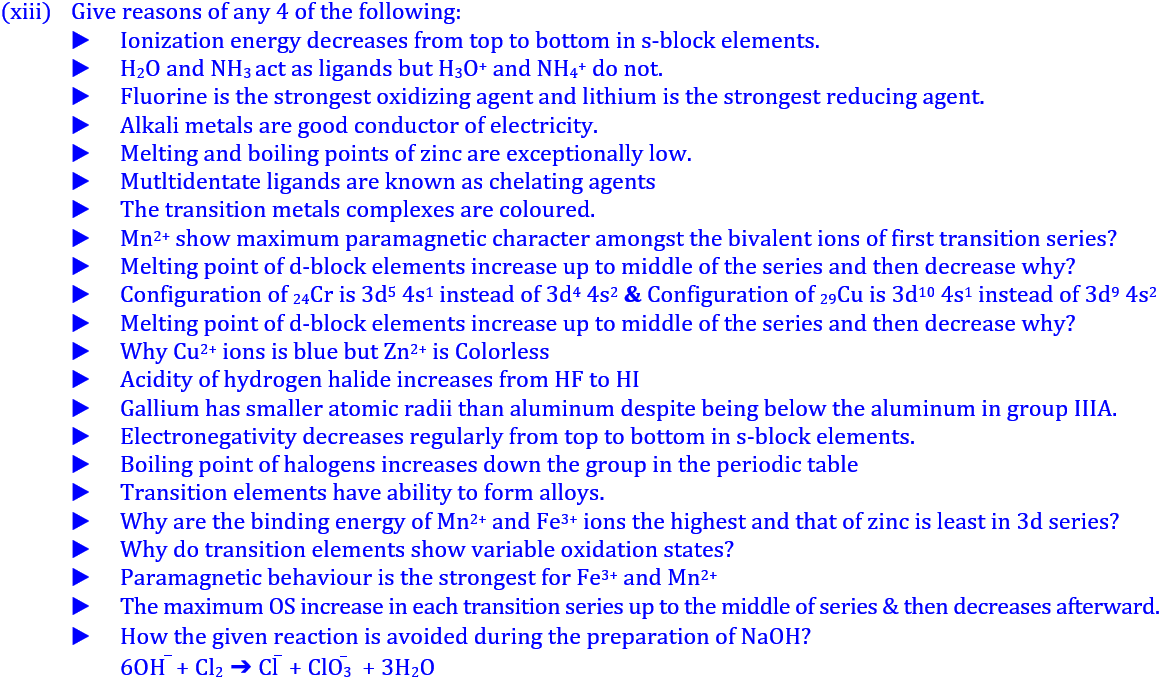
Q1. Give reason for the any FOUR of the following:
▶ Boiling points of halogens increase down the group in the periodic table.
▶ Gallium has smaller atomic radii than aluminium despite being below the aluminium in group IIIA.
▶ Acidity of hydrogen halides increase from HF to HI.
▶ Configuration of ₂₄Cr is 3d⁵ 4s¹ instead of 3d⁴ 4s² & Configuration of ₂₉Cu is 3d¹⁰ 4s¹ instead of 3d⁹ 4s²
▶ The transition metals complexes are coloured.
▶ The maximum oxidation states increase in each transition series up to the middle of series and then decreases afterward.
Q2. What is flame test? What is the basis of flame test? Mention the colour flame of s-block elements.
Q3. What is meant by a diagonal relationship? Mention three pairs of representative elements that show diagonal relationship. Write down two points to show the similarity of any TWO diagonal members.
Q4. Write down complete balanced chemical equations of the any FOUR of the following reactions:
▶ Bleaching powder is dissolved in water.
▶ Fluorine reacts with oxygen
▶ phosphorus reacts vigorously with water
▶ sulphur reacts at high temperature with water
▶ silicon is heated with nitrogen at high temperatures.
▶ Reaction of permanganate with oxalic acid
▶ Reaction of dichromate with ferrous sulphate
▶ Reaction of conc. Nitric acid with copper
Q5. What is meant by binding energy? Explain the trend of binding energy in 3d series of transitions elements
Q6. Define functional group and write the structure of four oxygen-containing functional groups and four nitrogen-containing functional groups.
OR
Write down TWO differences between any TWO of the following with examples
(i) Aliphatic and aromatic compounds
(ii) Saturated and unsaturated compounds
(iii) Aldehydic and Keto Groups
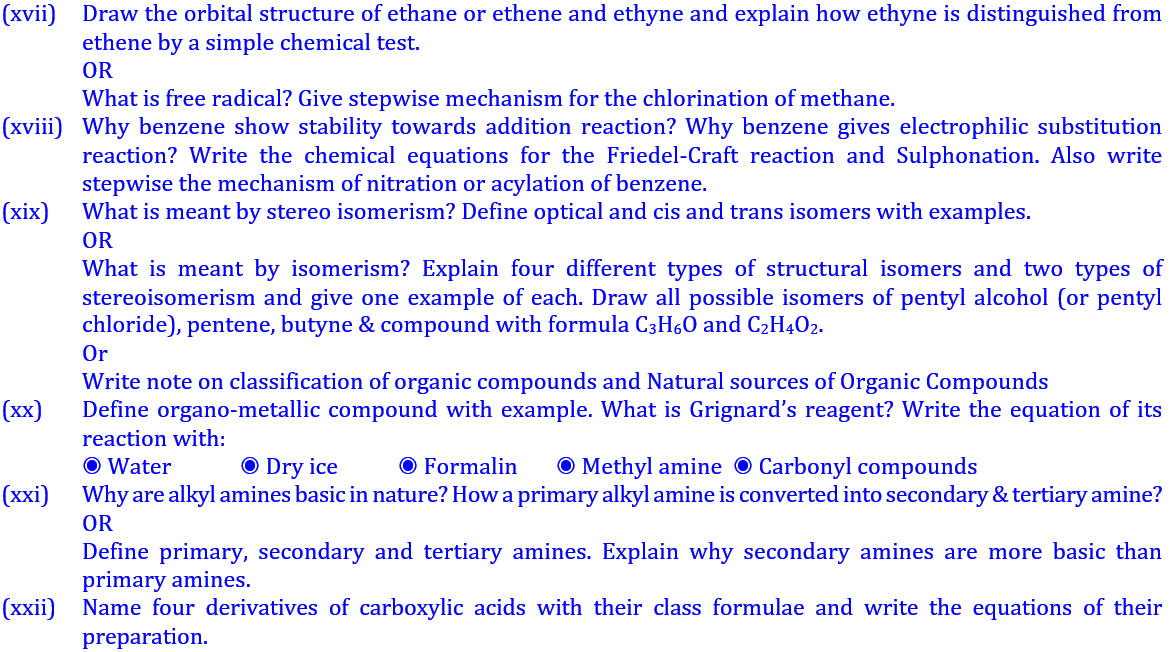
Q7. Explain the acidic nature of terminal alkynes giving two reactions of ethyne to show their acidic behaviour. Also show the relation between acid strength with the nature of hybrid orbitals.
Q8. Write the chemical equations for the Friedel-Craft reaction and Sulphonation. Also write stepwise the mechanism of nitration or acylation of benzene (only equations and headings).
OR
Write note on classification of organic compounds
Q9. What is meant by stereo isomerism? Define optical and cis and trans isomers with examples.
Q10. Explain Four different types of structural isomerism and give one example of each. Draw all possible isomers & compounds with formula C3H6O.
Q11. Give two methods of preparations for ethylene and ethyne.
Q12. Describe following reactions of alkene Epoxidation, Ozonolysis, Halohydration, polymerization.
Long Questions
Q13. (a) Discuss the group trend of atomic radii, melting and boiling points, and oxidation states of alkali metals.
(b) Draw a flow diagram of contact process and describe various steps involved in the manufacturing of sulphuric acid.
Q14. (a) What is free radical? Give stepwise mechanism for the chlorination of methane.
(b) Explain the trend of following properties of 3d series of transition elements
(i) Paramagnetic behaviour (ii) Variable oxidation state (iii) Colour formation
(c) What is meant by orientation of benzene? Explain ortho-para and meta directing groups. Write the equation for the preparation of the following compounds from benzene.
* m-nitrotoluene *m-nitrobenzoic acid * o and p-nitrotoluene
Tags
12th
chemistry long questions 2025
chemistry notes for board exam 2025
class 12 chemistry paper scheme 2025
inter part 2 model paper 2025
MCQs with answers 2025
Second year