

Welcome to Inamjazbi's Chemistry Hub! 🧬 Here, we dive deep into the fascinating world of chemistry. Whether you're prepping for exams or exploring analytical techniques, this blog has all the insights you need to master Chapter 7!




Important Differences


🧪📘🧠 Model Test Questions — X Chemistry
🔍 Analytical Chemistry — Chapter #7 • Test #8
✍️ Short Answer Questions
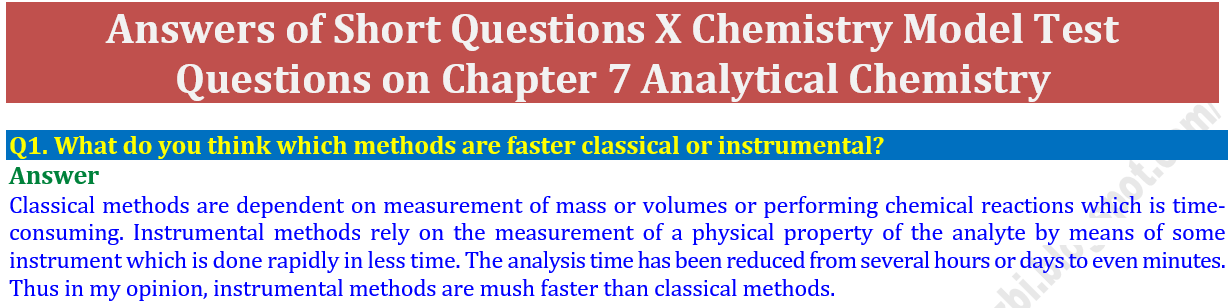
Q1. ⚡ What do you think which methods are faster: classical or instrumental?
Q2. 🔍 How will you compare the analytical techniques to one another?
Q3. ❌ Can you give some examples of error related to your life?
Q4. 📊 What do you mean by quantitative and qualitative analysis?
Q5. ⚗️ Discriminate which of the following collected volumes of a gas in gas preparation is accurate, precise, both, or none:
| Result 1 (cm³) | Result 2 (cm³) |
|---|---|
| 32 | 32 |
| 45 | 33 |
| 17 | 34 |
| 23 | 35 |
| Result 3 (cm³) | Result 4 (cm³) |
|---|---|
| 32 | 32 |
| 45 | 32 |
| 45 | 33 |
| 32 | 32 |
Q6. 🔋 Why we use potentiometric analysis in advanced instrumental methods?
Q7. 🌡️ How scientists are using infrared spectroscopy in quality control of different industries?
Q8. ⚡ List down the applications of conductometry.
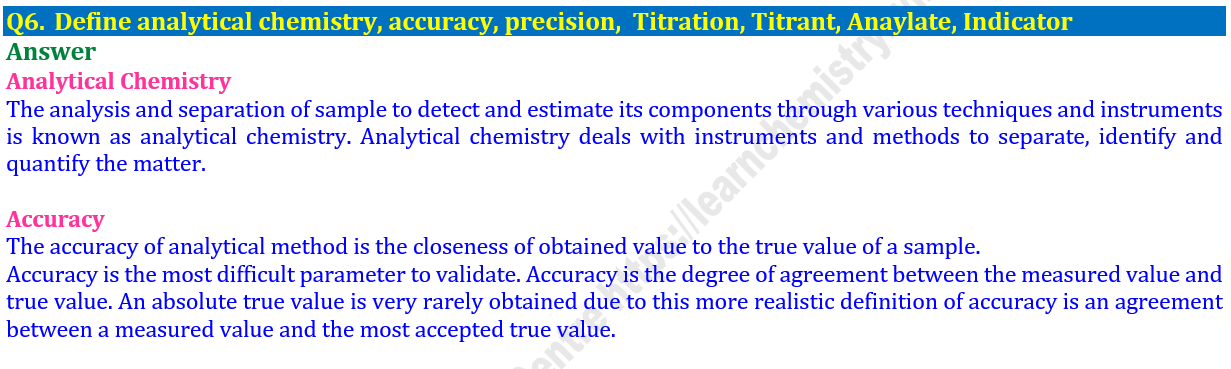
Q9. 📖 Define: analytical chemistry, accuracy, precision, titration, titrant, analyte, indicator.
Q10. ⚖️ Differentiate between Classical and Instrumental Methods.
Q11. 🔬 What are physical methods? Write names of four physical methods.
Q12. 📐 What is parameter? Write names of various parameters.
Q13. ❌ What is error? Write causes of errors with %, and types of errors.
Q14. 📊 Brief note on systematic & random errors with two examples each.
Q15. 🧪 What are Advanced Instrumental Methods? Write names of some.
📘 Detailed Answer Questions
Q1. 🧪 Distinguish between:
(a) Quantitative vs Qualitative analysis
(b) Titrimetric vs Gravimetric analysis
(a) Quantitative vs Qualitative analysis
(b) Titrimetric vs Gravimetric analysis
Q2. ⚡ Prove that instrumental analytical methods are more effective than classical methods.
Q3. 🔬 Describe gas chromatography in detail.
Q4. ⚡ Justify that electrochemical methods depend upon electrochemical cells.
Q5. 📊 What is Titrimetric Analysis? Describe how it is performed with diagram.
Q6. ⚖️ What is Gravimetric Analysis? Write 4 steps & 4 types.
🌈📘 Analytical Chemistry — MCQs with Answers
1️⃣ The analytical chemistry deals with instruments and methods to ________, identify and quantify the matter
🟦 (a) Mix
🟩 (b) Separate ✅ → Analytical chemistry separates, identifies, and quantifies matter.
🟨 (c) Differentiate
🟥 (d) Manipulate
🟩 (b) Separate ✅ → Analytical chemistry separates, identifies, and quantifies matter.
🟨 (c) Differentiate
🟥 (d) Manipulate
2️⃣ The sample may be solid, liquid, gas or a ___________ in qualitative analysis.
🟦 (a) Mixture ✅ → Qualitative analysis often deals with mixtures to identify components.
🟩 (b) Compound
🟨 (c) Substance
🟥 (d) None of these
🟩 (b) Compound
🟨 (c) Substance
🟥 (d) None of these
3️⃣ Flame test of Copper Halide with bluish green color identifies the presence of:
🟦 (a) Halogen
🟩 (b) Hydrogen
🟨 (c) Copper ✅ → Copper salts give a characteristic bluish green flame.
🟥 (d) b and c
🟩 (b) Hydrogen
🟨 (c) Copper ✅ → Copper salts give a characteristic bluish green flame.
🟥 (d) b and c
4️⃣ The error caused by improper functioning of instrument is:
🟦 (a) Determinant Error
🟩 (b) Indeterminate Error
🟨 (c) Systematic Error
🟥 (d) Both a & c ✅ → Instrument faults cause systematic/determinant errors.
🟩 (b) Indeterminate Error
🟨 (c) Systematic Error
🟥 (d) Both a & c ✅ → Instrument faults cause systematic/determinant errors.
5️⃣ An agreement between a measured value and the accepted true value is:
🟦 (a) Error
🟩 (b) Accuracy ✅ → Accuracy means closeness to the true value.
🟨 (c) Precision
🟥 (d) All of these
🟩 (b) Accuracy ✅ → Accuracy means closeness to the true value.
🟨 (c) Precision
🟥 (d) All of these
6️⃣ Spectroscopy is the interaction of light with:
🟦 (a) Liquid
🟩 (b) Solid
🟨 (c) Gas
🟥 (d) Matter ✅ → Spectroscopy studies light interacting with matter in any state.
🟩 (b) Solid
🟨 (c) Gas
🟥 (d) Matter ✅ → Spectroscopy studies light interacting with matter in any state.
7️⃣ It is used to assess concentration or amount of given atomic, molecular or ionic chemical.
🟦 (a) Chromatography
🟩 (b) Spectroscopy ✅ → Spectroscopy measures concentration via absorbance/emission.
🟨 (c) Conductometry
🟥 (d) Potentiometry
🟩 (b) Spectroscopy ✅ → Spectroscopy measures concentration via absorbance/emission.
🟨 (c) Conductometry
🟥 (d) Potentiometry
8️⃣ Analysis dealing with identification of functional groups in compounds is:
🟦 (a) Physical qualitative analysis
🟩 (b) Analytical qualitative analysis
🟨 (c) Organic qualitative analysis ✅ → Organic qualitative analysis detects functional groups.
🟥 (d) Inorganic qualitative analysis
🟩 (b) Analytical qualitative analysis
🟨 (c) Organic qualitative analysis ✅ → Organic qualitative analysis detects functional groups.
🟥 (d) Inorganic qualitative analysis
9️⃣ The gas is mobile phase in:
🟦 (a) Liquid chromatography
🟩 (b) Solid chromatography
🟨 (c) Gas chromatography ✅ → Gas chromatography uses gas as mobile phase.
🟥 (d) None of these
🟩 (b) Solid chromatography
🟨 (c) Gas chromatography ✅ → Gas chromatography uses gas as mobile phase.
🟥 (d) None of these
🔟 The physical methods used to measure physical properties is called:
🟦 (a) Combustion analysis method
🟩 (b) Atomic emission spectroscopy method ✅ → AES measures physical property (light emission).
🟨 (c) Volumetric analysis method
🟥 (d) Gravimetric analysis method
🟩 (b) Atomic emission spectroscopy method ✅ → AES measures physical property (light emission).
🟨 (c) Volumetric analysis method
🟥 (d) Gravimetric analysis method
🌈📘✨ Smart Answers of Short Questions
🧪 X Chemistry — Model Test Questions • Chapter 7 Analytical Chemistry
❓ Q1. What do you think which methods are faster classical or instrumental?
✅ Answer: Instrumental methods are faster than classical methods because they use automated instruments,
require less manual work, and give rapid and accurate results. ⚗️ Classical methods involve lengthy procedures
like titration and gravimetric analysis. ⏱️ Instrumental methods save time and are more efficient 🔬.
❓ Q2. How will you compare the analytical techniques to one another?
✅ Answer: Analytical techniques can be compared based on several factors:
🔬 Sensitivity — how small an amount they can detect.
⚡ Speed — how quickly results are obtained.
📊 Accuracy & Precision — closeness to true value and reproducibility.
💰 Cost & Accessibility — whether instruments are expensive or methods are simple.
🧪 Nature of Sample — solid, liquid, gas, or complex mixtures.
Classical methods (like titration or gravimetry) are simple and inexpensive but slower, while instrumental methods (like spectroscopy or chromatography) are faster, more sensitive, and suitable for complex analyses. 🌈
❓ Q3. Can you give some examples of error related to your life?
✅ Answer:
➡️ ⚖️ When weighing yourself on a scale, you position yourself slightly differently each time.
➡️ ⚗️ When taking a volume reading in a flask, you may read the value from a different angle each time.
➡️ 🌬️ Measuring the mass of a sample on an analytical balance may produce different values as air currents affect the balance.
➡️ 📏 Measuring your height is affected by minor posture changes.
➡️ ✍️ Writing an incorrect number.
➡️ ⌨️ Hitting the wrong key on a calculator.
➡️ 🔄 If two people are rounding, and one rounds down and the other rounds up, a procedural error occurs.
➡️ ➕➖ Incorrect arithmetic operations or missing a negative sign cause computational errors.
➡️ 👁️ Failure to read the meniscus at eye level causes parallax error, giving consistently high or low volume readings depending on the viewing angle.
➡️ 🌡️ Length measured with a metal ruler changes with temperature due to thermal expansion, giving different readings in hot and cold conditions.
➡️ 🌡️ An improperly calibrated thermometer may be accurate over a limited range but give incorrect readings at higher or lower temperatures.
➡️ 📏 Distances measured with a stretched cloth tape differ from a new one; such proportional discrepancies are called scale factor errors.
➡️ 🌡️ A change in room temperature during measurement (e.g., power outage) can alter body temperature and affect the reading.
➡️ ⚖️ When weighing yourself on a scale, you position yourself slightly differently each time.
➡️ ⚗️ When taking a volume reading in a flask, you may read the value from a different angle each time.
➡️ 🌬️ Measuring the mass of a sample on an analytical balance may produce different values as air currents affect the balance.
➡️ 📏 Measuring your height is affected by minor posture changes.
➡️ ✍️ Writing an incorrect number.
➡️ ⌨️ Hitting the wrong key on a calculator.
➡️ 🔄 If two people are rounding, and one rounds down and the other rounds up, a procedural error occurs.
➡️ ➕➖ Incorrect arithmetic operations or missing a negative sign cause computational errors.
➡️ 👁️ Failure to read the meniscus at eye level causes parallax error, giving consistently high or low volume readings depending on the viewing angle.
➡️ 🌡️ Length measured with a metal ruler changes with temperature due to thermal expansion, giving different readings in hot and cold conditions.
➡️ 🌡️ An improperly calibrated thermometer may be accurate over a limited range but give incorrect readings at higher or lower temperatures.
➡️ 📏 Distances measured with a stretched cloth tape differ from a new one; such proportional discrepancies are called scale factor errors.
➡️ 🌡️ A change in room temperature during measurement (e.g., power outage) can alter body temperature and affect the reading.
❓ Q4. What do you mean by quantitative and qualitative analysis?
✅ Answer:
🔎 1. Qualitative Analysis
✨ Identification of elements, ions, or compounds present in a sample — focusing on their presence (quality), not quantity.
✨ (i) Organic Qualitative Analysis
🧪 Identifies classes of organic compounds or functional groups through characteristic colour changes.
➡️ Example: A white precipitate forms when silver nitrate (AgNO₃) in dilute nitric acid (HNO₃) is added, indicating halide ions (F, Cl, Br, I).
✨ (ii) Inorganic Qualitative Analysis
🔬 Identifies elements using chemical tests.
➡️ Example: Flame test of copper halides shows bluish‑green colour due to copper presence.
🔎 2. Quantitative Analysis
✨ Determines the exact amount or concentration of one or more substances in a sample.
🌈 Physical Methods
📊 Measure physical properties such as density, temperature, light absorption, magnetic influences, colour, and texture.
➡️ Techniques: FTIR, AES, trace element analysis, EDS.
🌈 Chemical Methods
⚗️ Use chemical reactions (precipitation, oxidation, neutralization) to determine amounts.
➡️ Techniques: Volumetric analysis, Gravimetric analysis, Combustion analysis.
🔎 1. Qualitative Analysis
✨ Identification of elements, ions, or compounds present in a sample — focusing on their presence (quality), not quantity.
✨ (i) Organic Qualitative Analysis
🧪 Identifies classes of organic compounds or functional groups through characteristic colour changes.
➡️ Example: A white precipitate forms when silver nitrate (AgNO₃) in dilute nitric acid (HNO₃) is added, indicating halide ions (F, Cl, Br, I).
✨ (ii) Inorganic Qualitative Analysis
🔬 Identifies elements using chemical tests.
➡️ Example: Flame test of copper halides shows bluish‑green colour due to copper presence.
🔎 2. Quantitative Analysis
✨ Determines the exact amount or concentration of one or more substances in a sample.
🌈 Physical Methods
📊 Measure physical properties such as density, temperature, light absorption, magnetic influences, colour, and texture.
➡️ Techniques: FTIR, AES, trace element analysis, EDS.
🌈 Chemical Methods
⚗️ Use chemical reactions (precipitation, oxidation, neutralization) to determine amounts.
➡️ Techniques: Volumetric analysis, Gravimetric analysis, Combustion analysis.
❓ Q5. Discriminate which of the following collected volumes of a gas in gas preparation are accurate, precise, both, or none?
✅ Answer:
📊 Result 1 vs Result 2
➡️ Result 1: ❌ Not precise, ❌ Not accurate
➡️ Result 2: 🎯 Precise, ❌ Not accurate
📊 Result 3 vs Result 4
➡️ Result 3: 🎯 Precise, ❌ Not accurate
➡️ Result 4: 🎯 Precise, ✅ Accurate
📊 Result 1 vs Result 2
| Result 1 (cm³) | Result 2 (cm³) |
|---|---|
| 32 | 32 |
| 45 | 33 |
| 17 | 34 |
| 23 | 35 |
➡️ Result 2: 🎯 Precise, ❌ Not accurate
📊 Result 3 vs Result 4
| Result 3 (cm³) | Result 4 (cm³) |
|---|---|
| 32 | 32 |
| 45 | 32 |
| 45 | 33 |
| 32 | 32 |
➡️ Result 4: 🎯 Precise, ✅ Accurate
❓ Q6. Define analytical chemistry, accuracy, precision, titration, titrant, analyte, indicator
✅ Answer:
🔬 Analytical Chemistry
The analysis and separation of a sample to detect and estimate its components through various techniques and instruments. It deals with methods to separate, identify, and quantify matter.
🎯 Accuracy
The closeness of an obtained value to the true value of a sample. It is the degree of agreement between the measured value and the most accepted true value.
📏 Precision
The degree of agreement between replicate measurements of the same quantity. It reflects repeatability and exactness of results.
⚗️ Titration
The comparison of the volume of a solution of known concentration with the volume of a solution of unknown concentration.
💧 Titrant
A solution of known concentration added to another solution to determine the concentration of a second chemical species (e.g., NaOH, HCl).
🧪 Analyte
The chemical substance that is the subject of analysis or whose constituents are measured (e.g., 24‑karat gold, NaCl, water).
🎨 Indicator
A substance that changes colour in acidic or alkaline solutions (e.g., litmus, phenolphthalein, methyl orange).
🔬 Analytical Chemistry
The analysis and separation of a sample to detect and estimate its components through various techniques and instruments. It deals with methods to separate, identify, and quantify matter.
🎯 Accuracy
The closeness of an obtained value to the true value of a sample. It is the degree of agreement between the measured value and the most accepted true value.
📏 Precision
The degree of agreement between replicate measurements of the same quantity. It reflects repeatability and exactness of results.
⚗️ Titration
The comparison of the volume of a solution of known concentration with the volume of a solution of unknown concentration.
💧 Titrant
A solution of known concentration added to another solution to determine the concentration of a second chemical species (e.g., NaOH, HCl).
🧪 Analyte
The chemical substance that is the subject of analysis or whose constituents are measured (e.g., 24‑karat gold, NaCl, water).
🎨 Indicator
A substance that changes colour in acidic or alkaline solutions (e.g., litmus, phenolphthalein, methyl orange).
❓ Q7. Why we use potentiometric analysis in advance instrumental methods?
✅ Answer:
⚡ Potentiometry is used in electroanalytical chemistry to determine solute concentration in solution. 📏 The potential between two electrodes is measured by a voltmeter, with no current flow.
🌍 Applications:
➡️ Analysis of pollutants in water 💧
➡️ Pharmaceutical and drug testing 💊
➡️ Quality control in food industry 🍞
➡️ Clinical chemistry 🧪
⚡ Potentiometry is used in electroanalytical chemistry to determine solute concentration in solution. 📏 The potential between two electrodes is measured by a voltmeter, with no current flow.
🌍 Applications:
➡️ Analysis of pollutants in water 💧
➡️ Pharmaceutical and drug testing 💊
➡️ Quality control in food industry 🍞
➡️ Clinical chemistry 🧪
❓ Q8. How scientists are using infrared spectroscopy in quality control of different industries?
✅ Answer:
🌈 Infrared Spectroscopy (introduced in 1950) qualifies and quantifies sample information quickly and cost‑effectively. 🛡️ It is non‑hazardous since no polluting chemicals are required. 🎶 Also known as vibrational spectroscopy.
📊 Applications:
➡️ Identification of functional groups in food products 🍫
➡️ Analysis of polymers 🧵
➡️ Industrial quality control 🏭
🌈 Infrared Spectroscopy (introduced in 1950) qualifies and quantifies sample information quickly and cost‑effectively. 🛡️ It is non‑hazardous since no polluting chemicals are required. 🎶 Also known as vibrational spectroscopy.
📊 Applications:
➡️ Identification of functional groups in food products 🍫
➡️ Analysis of polymers 🧵
➡️ Industrial quality control 🏭
❓ Q9. List down the applications of conductometry?
✅ Answer:
⚡ Conductometry is an analytical technique based on measuring electrical conductance. 📟 Device used: Conductivity meter.
🌍 Applications:
1️⃣ Determination of degree of dissociation constant 🔬
2️⃣ Measurement of solubility of sparingly soluble salts 💧
3️⃣ Study of rate constant of a reaction ⏱️
4️⃣ Determination of titration end point ⚗️
⚡ Conductometry is an analytical technique based on measuring electrical conductance. 📟 Device used: Conductivity meter.
🌍 Applications:
1️⃣ Determination of degree of dissociation constant 🔬
2️⃣ Measurement of solubility of sparingly soluble salts 💧
3️⃣ Study of rate constant of a reaction ⏱️
4️⃣ Determination of titration end point ⚗️
❓ Q10. What are physical methods? Write down only names of four physical methods.
✅ Answer:
📊 Physical methods measure properties such as density, temperature, absorption of light, magnetic influences, colour, and texture.
🔎 Examples (Four Physical Methods):
1️⃣ Fourier Transform Infrared Spectroscopy (FTIR) 🌈
2️⃣ Atomic Emission Spectroscopy (AES) 🔬
3️⃣ Trace Element Analysis ⚗️
4️⃣ Energy Dispersive X‑ray Spectroscopy (EDS) 💡
📊 Physical methods measure properties such as density, temperature, absorption of light, magnetic influences, colour, and texture.
🔎 Examples (Four Physical Methods):
1️⃣ Fourier Transform Infrared Spectroscopy (FTIR) 🌈
2️⃣ Atomic Emission Spectroscopy (AES) 🔬
3️⃣ Trace Element Analysis ⚗️
4️⃣ Energy Dispersive X‑ray Spectroscopy (EDS) 💡
❓ Q11. Differentiate between Classical and Instrumental Methods
✅ Answer:
📊 Difference between Classical and Instrumental Methods
📊 Difference between Classical and Instrumental Methods
| ⚗️ Classical Methods | 🔬 Instrumental Methods |
|---|---|
| Procedure is simple and accurate | Procedure is sensitive and technical |
| Based on chemical reactions | Based on instrumental measurements |
| Use simple laboratory apparatus | Use advanced instruments |
| Equipment needed is cheap | Equipment needed is expensive |
| Methods based on absolute measurement | Methods based on reliable measurement |
| No specialized training required | Specialized training required |
| Accuracy decreases with smaller amounts | Accuracy depends on instruments |
| Determination is slow / time‑consuming | Determination is very fast / rapid analysis |
| Large sample amount needed | Small sample amount sufficient |
| Less sensitive and less accurate | Highly sensitive and accurate |
| Suitable for routine analysis | Suitable for trace analysis |
| Examples: titration, gravimetric analysis | Examples: spectroscopy, chromatography |
❓ Q12. What is parameter? Write down names of various parameters.
✅ Answer:
📊 A parameter is a measurable factor or boundary that defines performance and quality of analytical methods. 🔎 Validation of an analytical method is observed by parameters.
🌈 Various Parameters:
➡️ Selectivity 🎯
➡️ Linearity 📈
➡️ Range 📏
➡️ Accuracy ✔️
➡️ Precision 🔬
➡️ Error ❌
📊 A parameter is a measurable factor or boundary that defines performance and quality of analytical methods. 🔎 Validation of an analytical method is observed by parameters.
🌈 Various Parameters:
➡️ Selectivity 🎯
➡️ Linearity 📈
➡️ Range 📏
➡️ Accuracy ✔️
➡️ Precision 🔬
➡️ Error ❌
❓ Q13. What is error? Write down causes of errors with their %. Give names of types of errors.
✅ Answer:
❌ Error: The numerical difference between observed value and true value.
⚡ Causes of Errors:
➡️ 13% Equipment failure ⚙️
➡️ 13% Human error 👩🔬
➡️ 16% Sample preparation 🧪
➡️ 10% Wrong calibration 📏
📊 Types of Errors:
(i) Systematic error 🔧
(ii) Random error 🎲
❌ Error: The numerical difference between observed value and true value.
⚡ Causes of Errors:
➡️ 13% Equipment failure ⚙️
➡️ 13% Human error 👩🔬
➡️ 16% Sample preparation 🧪
➡️ 10% Wrong calibration 📏
📊 Types of Errors:
(i) Systematic error 🔧
(ii) Random error 🎲
❓ Q14. Write down brief note systematic and random errors with two examples each.
✅ Answer:
🔧 Systematic Errors / Determinate Errors
➡️ Caused by defects in analytical method or improper functioning of instruments. ➡️ Types: instrumental, observational, environmental, theoretical.
📌 Examples:
1️⃣ Thermometer, pipette, burette, analytical balance showing consistent measurement error. 🌡️
2️⃣ Acid‑base titration with improperly prepared pH indicator or unclean burette causing early colour change. ⚗️
🎲 Random Errors / Indeterminate Errors
➡️ Caused by variations in procedure, environment, or instrument limitations. ➡️ Unavoidable, may be positive or negative.
📌 Examples:
1️⃣ Measuring mass on analytical balance gives varying readings due to air or moisture effects. ⚖️
2️⃣ Reading burette volume only to nearest 0.1 cm³ introduces unavoidable variation. 📏
🔎 Random errors are reduced by taking multiple readings and averaging results.
🔧 Systematic Errors / Determinate Errors
➡️ Caused by defects in analytical method or improper functioning of instruments. ➡️ Types: instrumental, observational, environmental, theoretical.
📌 Examples:
1️⃣ Thermometer, pipette, burette, analytical balance showing consistent measurement error. 🌡️
2️⃣ Acid‑base titration with improperly prepared pH indicator or unclean burette causing early colour change. ⚗️
🎲 Random Errors / Indeterminate Errors
➡️ Caused by variations in procedure, environment, or instrument limitations. ➡️ Unavoidable, may be positive or negative.
📌 Examples:
1️⃣ Measuring mass on analytical balance gives varying readings due to air or moisture effects. ⚖️
2️⃣ Reading burette volume only to nearest 0.1 cm³ introduces unavoidable variation. 📏
🔎 Random errors are reduced by taking multiple readings and averaging results.
❓ Q15. What are Advanced Instrumental Methods? Write down names of some Advanced Instrumental Methods
✅ Answer:
🔬 Advanced instrumental methods are modern techniques of analytical chemistry that involve the use of instruments for analysis and separation of mixtures and compounds. 📊 They are applied in both quantitative and qualitative analysis.
🌈 Examples of Advanced Instrumental Methods:
1️⃣ Spectroscopy 🔦
2️⃣ Ultraviolet & Visible Spectroscopy 🌞👁️
3️⃣ Infrared Spectroscopy 🌡️
4️⃣ Electrochemical Methods ⚡
5️⃣ Potentiometric & Conductometry 📟
6️⃣ Chromatography 🧪
7️⃣ High Performance Liquid Chromatography (HPLC) 💧
8️⃣ Gas Chromatography 🌬️
🔬 Advanced instrumental methods are modern techniques of analytical chemistry that involve the use of instruments for analysis and separation of mixtures and compounds. 📊 They are applied in both quantitative and qualitative analysis.
🌈 Examples of Advanced Instrumental Methods:
1️⃣ Spectroscopy 🔦
2️⃣ Ultraviolet & Visible Spectroscopy 🌞👁️
3️⃣ Infrared Spectroscopy 🌡️
4️⃣ Electrochemical Methods ⚡
5️⃣ Potentiometric & Conductometry 📟
6️⃣ Chromatography 🧪
7️⃣ High Performance Liquid Chromatography (HPLC) 💧
8️⃣ Gas Chromatography 🌬️
🌈📘✨ Smart Answers of Detailed Questions
🧪 X Chemistry — Model Test Questions • Chapter 7 Analytical Chemistry
❓ Q1. Distinguish between the following:
(a) Quantitative analysis and qualitative analysis
(b) Titrimetric analysis and gravimetric analysis
(a) Quantitative analysis and qualitative analysis
(b) Titrimetric analysis and gravimetric analysis
✅ Answer:
⚔️ Quantitative 🆚 Qualitative Analysis
⚔️ Gravimetric 🆚 Titrimetric Analysis
⚔️ Quantitative 🆚 Qualitative Analysis
| 📊 Quantitative Analysis | 🔎 Qualitative Analysis |
|---|---|
| Determines how much of a substance is present | Identifies what substance is present |
| Concerned with amount or concentration | Concerned with nature/identity |
| Involves numerical measurements | Does not involve numerical values |
| Answer is numerical | Answer is descriptive |
| Numerical results (e.g., 0.25 M NaOH, 5.6 g salt) | Observational results (e.g., lilac flame → K⁺, white precipitate → AgCl) |
| Examples: titration, gravimetric analysis, spectroscopy, chromatography | Examples: flame test, precipitation test, odor |
⚔️ Gravimetric 🆚 Titrimetric Analysis
| ⚖️ Gravimetric Analysis | ⚗️ Titrimetric Analysis |
|---|---|
| Based on measurement of mass (precipitate or residue) | Based on measurement of volume of a standard solution |
| Involves precipitation and weighing | Involves titration with standard solution |
| More time‑consuming | Faster method |
| Very accurate | Comparatively less accurate |
| Requires complete precipitation | Requires clear end point |
| Basic reaction: precipitation | Basic reaction: neutralization or redox |
| Based on law of conservation of mass | Based on stoichiometry of chemical reactions |
| Process: convert analyte into insoluble compound → filter, dry, weigh | Process: add titrant to analyte until endpoint (indicator shows completion) |
| Requires analytical balance, crucibles, furnace | Requires burette, pipette, indicators, standard solutions |
| Results expressed in mg, g, or kg | Results expressed in mL or L |
| Example: estimation of chloride as AgCl | Example: acid‑base titration (HCl vs NaOH), redox titration (KMnO₄ vs Fe²⁺) |
❓ Q2. Prove that instrumental analytical methods are more effective than classical analytical methods?
✅ Answer:
⚡ Effectiveness of Instrumental Methods:
➡️ Faster ⏱️ — provide rapid results compared to lengthy classical procedures.
➡️ More accurate ✔️ — minimize human error and give results closer to true values.
➡️ Highly sensitive 🔬 — detect very low concentrations that classical methods cannot.
➡️ Require smaller samples 💧 — efficient use of materials.
➡️ Reliable and automated 🤖 — ensure consistency and reproducibility.
📊 Conclusion:
Instrumental methods are preferred because of their speed, accuracy, sensitivity, and automation. 🌟 Therefore, they are more effective than classical methods for precise and efficient analysis.
⚡ Effectiveness of Instrumental Methods:
➡️ Faster ⏱️ — provide rapid results compared to lengthy classical procedures.
➡️ More accurate ✔️ — minimize human error and give results closer to true values.
➡️ Highly sensitive 🔬 — detect very low concentrations that classical methods cannot.
➡️ Require smaller samples 💧 — efficient use of materials.
➡️ Reliable and automated 🤖 — ensure consistency and reproducibility.
📊 Conclusion:
Instrumental methods are preferred because of their speed, accuracy, sensitivity, and automation. 🌟 Therefore, they are more effective than classical methods for precise and efficient analysis.
❓ Q3. Describe gas chromatography in detail?
✅ Answer:
🌈 Gas Chromatography (GC) / Gas Liquid Chromatography
📖 Meaning:
Chromatography comes from Greek roots chroma (color) + graph (writing) → “color writing.”
Gas Chromatography (GC) is a technique for separation, identification, and quantification of volatile organic compounds by selective partitioning between:
➡️ Mobile phase (gas) 🚀
➡️ Stationary phase (liquid/solid in column) 🧴
Components are separated because they spend different amounts of time in each phase.
🎯 Purpose of Gas Chromatography:
➡️ 🔥 High volatility compounds
➡️ ⚖️ Low molecular weight substances
➡️ 🌡️ Thermally stable compounds
⚗️ Phases:
🚀 Mobile Phase: Inert carrier gas (helium, nitrogen).
🧴 Stationary Phase: Viscous liquid (long-chain hydrocarbon) coated on solid support (silica) inside a capillary column (few mm thick, up to 10 m long).
🧪 Principle of Gas Chromatography:
➡️ Components distribute differently between mobile and stationary phases.
➡️ Each compound has a unique ⏱️ Retention Time (Rt) → separated sequentially.
➡️ 📊 Detector records signals → chromatogram shows qualitative & quantitative data.
🔍 Applications:
🧪 Separation of volatile mixtures
🍎 Food analysis (quality & composition)
🌍 Detection of pollutants, pesticides, toxins
💊 Quality control in pharmaceuticals & chemicals
🍷 Blood alcohol detection
⛽ Petroleum hydrocarbon separation
🔬 Studying reaction mechanisms
✅ Advantages of Gas Chromatography:
⚡ Fast analysis
🎯 High sensitivity
🔍 Excellent separation efficiency
📉 Requires only small sample size
🌈 Gas Chromatography (GC) / Gas Liquid Chromatography
📖 Meaning:
Chromatography comes from Greek roots chroma (color) + graph (writing) → “color writing.”
Gas Chromatography (GC) is a technique for separation, identification, and quantification of volatile organic compounds by selective partitioning between:
➡️ Mobile phase (gas) 🚀
➡️ Stationary phase (liquid/solid in column) 🧴
Components are separated because they spend different amounts of time in each phase.
🎯 Purpose of Gas Chromatography:
➡️ 🔥 High volatility compounds
➡️ ⚖️ Low molecular weight substances
➡️ 🌡️ Thermally stable compounds
⚗️ Phases:
🚀 Mobile Phase: Inert carrier gas (helium, nitrogen).
🧴 Stationary Phase: Viscous liquid (long-chain hydrocarbon) coated on solid support (silica) inside a capillary column (few mm thick, up to 10 m long).
🧪 Principle of Gas Chromatography:
➡️ Components distribute differently between mobile and stationary phases.
➡️ Each compound has a unique ⏱️ Retention Time (Rt) → separated sequentially.
➡️ 📊 Detector records signals → chromatogram shows qualitative & quantitative data.
🔍 Applications:
🧪 Separation of volatile mixtures
🍎 Food analysis (quality & composition)
🌍 Detection of pollutants, pesticides, toxins
💊 Quality control in pharmaceuticals & chemicals
🍷 Blood alcohol detection
⛽ Petroleum hydrocarbon separation
🔬 Studying reaction mechanisms
✅ Advantages of Gas Chromatography:
⚡ Fast analysis
🎯 High sensitivity
🔍 Excellent separation efficiency
📉 Requires only small sample size
❓ Q4. Justify that electrochemical methods depend upon electrochemical cells. Also explain the construction and working of electrochemical cells.
✅ Answer:
⚡ Electrochemical Methods
Electrochemical methods are analytical techniques that measure potential, charge, or electrical properties of a solution. They are widely used for quantitative and qualitative analysis.
🔋 Electrochemical Cells — Basis of Electrochemical Methods
➡️ Electrochemical methods rely on electrochemical cells to supply voltage and current.
➡️ Electrochemical cells move ions between electrodes, enabling reactions and generating measurable current.
➡️ The concentration of electroactive species is determined using the current produced.
➡️ When equilibrium is reached in both half‑cells, net voltage becomes zero and electricity production stops.
🛠️ Construction of Electrochemical Cells
➡️ Consist of two half‑cells:
• Anode (e.g., Zn electrode in ZnSO₄ solution) ⚙️
• Cathode (e.g., Cu electrode in CuSO₄ solution) 🔩
➡️ Both electrodes are connected to a voltmeter 📟.
➡️ Anode: negative sign due to oxidation (electron release).
➡️ Cathode: positive sign due to reduction (electron consumption).
➡️ Salt bridge (NaCl) provides ionic connectivity without mixing solutions 🌉.
⚙️ Working of Electrochemical Cells
➡️ At anode: Zinc oxidizes → Zn²⁺ ions formed, electrons released (negative sign).
➡️ At cathode: Copper ions reduced → electrons consumed (positive sign).
➡️ Ion movement (Zn²⁺, Cu²⁺) creates charge imbalance, halting reactions unless neutralized.
➡️ Salt bridge ions migrate: anions → anode, cations → cathode, maintaining neutrality.
➡️ Voltmeter measures cell potential (E°cell ≈ +1.11 V when Zn electrode is connected to negative terminal and SHE to positive terminal).
🌟 Conclusion:
Electrochemical methods fundamentally depend on electrochemical cells, as they provide the platform for reactions, ion movement, and measurable electrical properties essential for analysis.![]()

⚡ Electrochemical Methods
Electrochemical methods are analytical techniques that measure potential, charge, or electrical properties of a solution. They are widely used for quantitative and qualitative analysis.
🔋 Electrochemical Cells — Basis of Electrochemical Methods
➡️ Electrochemical methods rely on electrochemical cells to supply voltage and current.
➡️ Electrochemical cells move ions between electrodes, enabling reactions and generating measurable current.
➡️ The concentration of electroactive species is determined using the current produced.
➡️ When equilibrium is reached in both half‑cells, net voltage becomes zero and electricity production stops.
🛠️ Construction of Electrochemical Cells
➡️ Consist of two half‑cells:
• Anode (e.g., Zn electrode in ZnSO₄ solution) ⚙️
• Cathode (e.g., Cu electrode in CuSO₄ solution) 🔩
➡️ Both electrodes are connected to a voltmeter 📟.
➡️ Anode: negative sign due to oxidation (electron release).
➡️ Cathode: positive sign due to reduction (electron consumption).
➡️ Salt bridge (NaCl) provides ionic connectivity without mixing solutions 🌉.
⚙️ Working of Electrochemical Cells
➡️ At anode: Zinc oxidizes → Zn²⁺ ions formed, electrons released (negative sign).
➡️ At cathode: Copper ions reduced → electrons consumed (positive sign).
➡️ Ion movement (Zn²⁺, Cu²⁺) creates charge imbalance, halting reactions unless neutralized.
➡️ Salt bridge ions migrate: anions → anode, cations → cathode, maintaining neutrality.
➡️ Voltmeter measures cell potential (E°cell ≈ +1.11 V when Zn electrode is connected to negative terminal and SHE to positive terminal).
🌟 Conclusion:
Electrochemical methods fundamentally depend on electrochemical cells, as they provide the platform for reactions, ion movement, and measurable electrical properties essential for analysis.
❓ Q5. What is Titrimetric Analysis? Describe how it is performed with diagram.
✅ Answer:
🔬 Titrimetric Analysis
A quantitative analytical method in which the concentration of an unknown solution (analyte) is determined by reacting it with a standard solution of known concentration (titrant) until the end point is reached, usually indicated by a color change of an indicator.
🎯 Purpose: To find the exact concentration of an unknown solution.
🔁 Other name: Volumetric analysis.
🧪 Titration:
The process of comparing the volume of a solution of known concentration with the volume of a solution of unknown concentration to determine its concentration.
💧 Titrant:
A solution of known concentration added from the burette to react with the analyte (unknown solution). ➡️ Examples: NaOH, HCl.
🔬 Analyte:
The substance of unknown concentration whose amount is determined during titration. ➡️ Examples: 24‑karat gold, NaCl, water sample.
🌈 Indicator:
A substance that changes colour at or near the end point of titration to signal completion. ➡️ Examples: litmus, phenolphthalein, methyl orange.
📋 Method of Titration 🛠️
General reaction: aA + tT → Product
• ‘a’ = number of moles of analyte (A)
• ‘t’ = number of moles of titrant (T)
🔎 Steps:
➡️ Place analyte solution in a volumetric flask.
➡️ Fill burette with titrant solution of known concentration.
➡️ Add indicator to analyte solution.
➡️ Gradually add titrant until end point (colour change) is reached.
➡️ Equivalence point = exact amount of titrant has reacted with analyte.
📊 Diagram:
![]()

🔬 Titrimetric Analysis
A quantitative analytical method in which the concentration of an unknown solution (analyte) is determined by reacting it with a standard solution of known concentration (titrant) until the end point is reached, usually indicated by a color change of an indicator.
🎯 Purpose: To find the exact concentration of an unknown solution.
🔁 Other name: Volumetric analysis.
🧪 Titration:
The process of comparing the volume of a solution of known concentration with the volume of a solution of unknown concentration to determine its concentration.
💧 Titrant:
A solution of known concentration added from the burette to react with the analyte (unknown solution). ➡️ Examples: NaOH, HCl.
🔬 Analyte:
The substance of unknown concentration whose amount is determined during titration. ➡️ Examples: 24‑karat gold, NaCl, water sample.
🌈 Indicator:
A substance that changes colour at or near the end point of titration to signal completion. ➡️ Examples: litmus, phenolphthalein, methyl orange.
📋 Method of Titration 🛠️
General reaction: aA + tT → Product
• ‘a’ = number of moles of analyte (A)
• ‘t’ = number of moles of titrant (T)
🔎 Steps:
➡️ Place analyte solution in a volumetric flask.
➡️ Fill burette with titrant solution of known concentration.
➡️ Add indicator to analyte solution.
➡️ Gradually add titrant until end point (colour change) is reached.
➡️ Equivalence point = exact amount of titrant has reacted with analyte.
📊 Diagram:
❓ Q6. What is meant by Gravimetric Analysis? Write down 4 Steps for its Gravimetric Analysis and its 4 Types
✅ Answer:
⚖️ Gravimetric Analysis
Gravimetric analysis is a quantitative method of chemical analysis in which the amount of an analyte is determined by measuring the mass of a solid product formed during a reaction. ➡️ It involves accurate determination of constituents by weight through selective precipitation from an aqueous solution.
⚗️ 4 Steps of Gravimetric Analysis
🧪➡️⚗️📉 React → Filter → Dry → Weigh → Calculate
➡️ Precipitation: Convert analyte into insoluble compound (precipitate) using a suitable reagent.
➡️ Filtration & Washing: Filter precipitate and wash to remove impurities.
➡️ Drying / Ignition: Dry or ignite precipitate to obtain constant mass.
➡️ Weighing & Calculation: Measure mass of precipitate and calculate analyte amount using stoichiometry.
📌 Example:
To determine chlorine (Cl) in AgCl solution:
(i) Prepare solution with known weight of AgCl.
(ii) Separate desired constituent (Cl).
(iii) Weigh separated constituent.
(iv) Compute amount of Cl in sample.
🧪 4 Types of Gravimetric Analysis
➡️ (a) Precipitation Gravimetry ⚗️ (Physical)
➡️ (b) Volatilization Gravimetry 🌡️ (Thermo)
➡️ (c) Thermogravimetric analysis (TGA) 🔥 (Precompetitive)
➡️ (d) Electrogravimetric Analysis ⚡ (Electrolytic Gravimetry)
⚖️ Gravimetric Analysis
Gravimetric analysis is a quantitative method of chemical analysis in which the amount of an analyte is determined by measuring the mass of a solid product formed during a reaction. ➡️ It involves accurate determination of constituents by weight through selective precipitation from an aqueous solution.
⚗️ 4 Steps of Gravimetric Analysis
🧪➡️⚗️📉 React → Filter → Dry → Weigh → Calculate
➡️ Precipitation: Convert analyte into insoluble compound (precipitate) using a suitable reagent.
➡️ Filtration & Washing: Filter precipitate and wash to remove impurities.
➡️ Drying / Ignition: Dry or ignite precipitate to obtain constant mass.
➡️ Weighing & Calculation: Measure mass of precipitate and calculate analyte amount using stoichiometry.
📌 Example:
To determine chlorine (Cl) in AgCl solution:
(i) Prepare solution with known weight of AgCl.
(ii) Separate desired constituent (Cl).
(iii) Weigh separated constituent.
(iv) Compute amount of Cl in sample.
🧪 4 Types of Gravimetric Analysis
➡️ (a) Precipitation Gravimetry ⚗️ (Physical)
➡️ (b) Volatilization Gravimetry 🌡️ (Thermo)
➡️ (c) Thermogravimetric analysis (TGA) 🔥 (Precompetitive)
➡️ (d) Electrogravimetric Analysis ⚡ (Electrolytic Gravimetry)
Important Differences
💥 جونؔ ایلیا 🎯 💥
💭 بے دلی کیا یوں ہی دن گزر جائیں گے
💔 صرف زندہ رہے ہم تو مر جائیں گے
💔 صرف زندہ رہے ہم تو مر جائیں گے
🎶 رقص ہے رنگ پر رنگ ہم رقص ہیں
🌌 سب بچھڑ جائیں گے سب بکھر جائیں گے
🌌 سب بچھڑ جائیں گے سب بکھر جائیں گے
🍷 یہ خراباتیان خرد باختہ
🌅 صبح ہوتے ہی سب کام پر جائیں گے
🌅 صبح ہوتے ہی سب کام پر جائیں گے
💕 کتنی دل کش ہو تم کتنا دلجو ہوں میں
⚡ کیا ستم ہے کہ ہم لوگ مر جائیں گے
⚡ کیا ستم ہے کہ ہم لوگ مر جائیں گے
🌟 ہے غنیمت کہ اسرار ہستی سے ہم
🕊️ بے خبر آئے ہیں بے خبر جائیں گے
🕊️ بے خبر آئے ہیں بے خبر جائیں گے
🔥 جونؔ ایلیا ۔ غزل 🔥
🌸 ہے بکھرنے کو یہ محفلِ رنگ و بُو، تم کہاں جاؤ گے ہم کہاں جائیں گے
🕊️ ہر طرف ہو رہی ہے یہی گفتگو، تم کہاں جاؤ گے ہم کہاں جائیں گے
🕊️ ہر طرف ہو رہی ہے یہی گفتگو، تم کہاں جاؤ گے ہم کہاں جائیں گے
💭 کوئی حاصل نہ تھا آرزو کا مگر، سانحہ یہ ہے اب آرزو بھی نہیں
⏳ وقت کی اس مسافت میں بے آرزو، تم کہاں جاؤ گے ہم کہاں جائیں گے
⏳ وقت کی اس مسافت میں بے آرزو، تم کہاں جاؤ گے ہم کہاں جائیں گے
🔥 ایک جنوں تھا کہ آباد ہو شہرِ جاں، اور آباد جب شہرِ جاں ہو گیا
🌌 ہیں یہ سرگوشیاں دربدر کوبکو، تم کہاں جاؤ گے ہم کہاں جائیں گے
🌌 ہیں یہ سرگوشیاں دربدر کوبکو، تم کہاں جاؤ گے ہم کہاں جائیں گے
🛤️ کس قدر دور سے لوٹ کر آئے ہیں، یوں کہوں عمر برباد کر آئے ہیں
💔 تھا سراب اپنا سرمایۂِ جستجو، تم کہاں جاؤ گے ہم کہاں جائیں گے
💔 تھا سراب اپنا سرمایۂِ جستجو، تم کہاں جاؤ گے ہم کہاں جائیں گے
🌿 دشت میں رقصِ شوقِ بہار اب کہاں، بعدِ پیمائ دیوانہ وار اب کہاں
🌙 بس گزرنے کو ہے موسمِ ہائے و ہُو، تم کہاں جاؤ گے ہم کہاں جائیں گے
🌙 بس گزرنے کو ہے موسمِ ہائے و ہُو، تم کہاں جاؤ گے ہم کہاں جائیں گے
🎶 ہر متاعِ نفس نذرِ آہنگ کی، ہم کو یاراں ہَوس تھی بہت رنگ کی
🌹 گُل زمیں سے ابلنے کو ہے اب لہو، تم کہاں جاؤ گے ہم کہاں جائیں گے؟
🌹 گُل زمیں سے ابلنے کو ہے اب لہو، تم کہاں جاؤ گے ہم کہاں جائیں گے؟
🌙 اولِ شب کا مہتاب بھی جا چکا، صحنِ مے خانہ سے اب افق میں کہیں
🍷 آخرِ شب ہے خالی ہیں جام و سُبو، تم کہاں جاؤ گے ہم کہاں جائیں گے؟
🍷 آخرِ شب ہے خالی ہیں جام و سُبو، تم کہاں جاؤ گے ہم کہاں جائیں گے؟
🌸 دشت میں رقصِ شوقِ بہار اب کہاں، بادہ پیمائی دیوانہ دار اب کہاں
🔥 بس گزرنے کو ہے موسمِ ہاؤ و ہُو، تم کہاں جاؤ گے ہم کہاں جائیں گے؟
🔥 بس گزرنے کو ہے موسمِ ہاؤ و ہُو، تم کہاں جاؤ گے ہم کہاں جائیں گے؟
💥 غزل ۔۔۔۔ جونؔ ایلیا 💥
🌸 کتنے عیش سے رہتے ہوں گے کتنے اتراتے ہوں گے
💭 جانے کیسے لوگ وہ ہوں گے جو اس کو بھاتے ہوں گے
💭 جانے کیسے لوگ وہ ہوں گے جو اس کو بھاتے ہوں گے
🌙 شام ہوئے خوش باش یہاں کے میرے پاس آ جاتے ہیں
🔥 میرے بجھنے کا نظارہ کرنے آ جاتے ہوں گے
🔥 میرے بجھنے کا نظارہ کرنے آ جاتے ہوں گے
🚶 وہ جو نہ آنے والا ہے نا اس سے مجھ کو مطلب تھا
💔 آنے والوں سے کیا مطلب آتے ہیں آتے ہوں گے
💔 آنے والوں سے کیا مطلب آتے ہیں آتے ہوں گے
🍃 اس کی یاد کی باد صبا میں اور تو کیا ہوتا ہوگا
🌌 یوں ہی میرے بال ہیں بکھرے اور بکھر جاتے ہوں گے
🌌 یوں ہی میرے بال ہیں بکھرے اور بکھر جاتے ہوں گے
🤝 یارو کچھ تو ذکر کرو تم اس کی قیامت بانہوں کا
💔 وہ جو سمٹتے ہوں گے ان میں وہ تو مر جاتے ہوں گے
💔 وہ جو سمٹتے ہوں گے ان میں وہ تو مر جاتے ہوں گے
🕊️ میرا سانس اکھڑتے ہی سب بین کریں گے روئیں گے
🌙 یعنی میرے بعد بھی یعنی سانس لیے جاتے ہوں گے
🌙 یعنی میرے بعد بھی یعنی سانس لیے جاتے ہوں گے
✍️ جونؔ ایلیا
💥 غزل ۔۔۔۔ جونؔ ایلیا 💥
🌙 زندانیانِ شام و سحر خیریت سے ہیں
💭 ہر لمحہ جی رہے ہیں مگر خیریت سے ہیں
💭 ہر لمحہ جی رہے ہیں مگر خیریت سے ہیں
🏙️ شہرِ یقیں میں اب کوئی دم خم نہیں رہا
🌌 دشتِ گماں کے خاک بسر خیریت سے ہیں
🌌 دشتِ گماں کے خاک بسر خیریت سے ہیں
🙏 آخر ہے کون جو کسی پل کہ سکے یہ بات
🕊️ اللہ اور تمام بشر خیریت سے ہیں
🕊️ اللہ اور تمام بشر خیریت سے ہیں
💡 ہے اپنے اپنے طور پہ ہر چیز اس گھڑی
💧 مژگانِ خشک و دامنِ تر خیریت سے ہیں
💧 مژگانِ خشک و دامنِ تر خیریت سے ہیں
👀 اب فیصلوں کا کم نظروں پر مدار ہے
🌟 یعنی تمام اہلِ نظر خیریت سے ہیں
🌟 یعنی تمام اہلِ نظر خیریت سے ہیں
🦶 پیروں سے آبلوں کا وہی ہے معاملہ
🔥 سودائیانِ حال کے سر خیریت سے ہیں
🔥 سودائیانِ حال کے سر خیریت سے ہیں
🏚️ ہم جن گھروں کو چھوڑ کے آئے تھے ناگہاں
💭 شکوے کی بات ہے، وہ اگر خیریت سے ہیں
💭 شکوے کی بات ہے، وہ اگر خیریت سے ہیں
🌬️ لو چل رہی ہے، محو ہے اپنے میں دوپہر
🏚️ خاک اڑ رہی ہے اور کھنڈر خیریت سے ہیں
🏚️ خاک اڑ رہی ہے اور کھنڈر خیریت سے ہیں
👥 ہم اہلِ شہر اپنے جوانوں کے درمیاں
✨ جونؔ! ایک معجزہ ہے اگر خیریت سے ہیں
✨ جونؔ! ایک معجزہ ہے اگر خیریت سے ہیں
🎨 برباد ہوچکا ہے ہنر اک ہنر کے ساتھ
📜 اور اپنے صاحبانِ ہنر خیریت سے ہیں
📜 اور اپنے صاحبانِ ہنر خیریت سے ہیں
🕊️ شکرِ خدا شہید ہوئے اہلِ حق تمام
⚔️ برگستوان و تیغ و تبر خیریت سے ہیں
⚔️ برگستوان و تیغ و تبر خیریت سے ہیں
🏰 اب اس کا قصرِ ناز کہاں اور وہ کہاں
🚪 بس در ہے اور بندئہ در خیریت سے ہیں
🚪 بس در ہے اور بندئہ در خیریت سے ہیں
✍️ ہم ہیں کہ شاعری ہے ہمارے لئے عذاب
📖 ورنہ تمام جوشؔ و جگرؔ خیریت سے ہیں
📖 ورنہ تمام جوشؔ و جگرؔ خیریت سے ہیں
📚 شاعر تو دو ہیں میرؔ تقی اور میر جونؔ
🌙 باقی جو ہیں وہ شام و سحر خیریت سے ہیں
🌙 باقی جو ہیں وہ شام و سحر خیریت سے ہیں
✍️ جونؔ ایلیا
💥 غزل ۔۔۔۔ جونؔ ایلیا 💥
🌅 ایک ہی مژدہ صبح لاتی ہے
☀️ دھوپ آنگن میں پھیل جاتی ہے
☀️ دھوپ آنگن میں پھیل جاتی ہے
🍃 رنگ موسم ہے اور بادِ صبا
🌆 شہر کوچوں میں خاک اڑاتی ہے
🌆 شہر کوچوں میں خاک اڑاتی ہے
📄 فرش پر کاغذ اڑتے پھرتے ہیں
🕰️ میز پر گرد جمتی جاتی ہے
🕰️ میز پر گرد جمتی جاتی ہے
💭 سوچتا ہوں کہ اس کی یاد آخر
🌙 اب کسے رات بھر جگاتی ہے
🌙 اب کسے رات بھر جگاتی ہے
🎶 میں بھی اذنِ نواگری چاہوں
💔 بے دلی بھی تو لب ہلاتی ہے
💔 بے دلی بھی تو لب ہلاتی ہے
🌳 سوگئے پیڑ جاگ اٹھی خوشبو
🌸 زندگی خواب کیوں دکھاتی ہے
🌸 زندگی خواب کیوں دکھاتی ہے
💔 اس سراپا وفا کی فرقت میں
💭 خواہشِ غیر کیوں ستاتی ہے
💭 خواہشِ غیر کیوں ستاتی ہے
🤝 آپ اپنے سے ہم سخن رہنا
😮 ہمنشیں! سانس پھول جاتی ہے
😮 ہمنشیں! سانس پھول جاتی ہے
😔 کیا ستم ہے کہ اب تِری صورت
👀 غور کرنے پہ یاد آتی ہے
👀 غور کرنے پہ یاد آتی ہے
🏚️ کون اس گھر کی دیکھ بھال کرے
💔 روز ایک چیز ٹوٹ جاتی ہے
💔 روز ایک چیز ٹوٹ جاتی ہے
✍️ جونؔ ایلیا
💥 غزل ۔۔۔۔ جونؔ ایلیا 💥
🌟 یہ ملکِ جاں یہ حقیقت نہ رائیگاں جائے
💭 یہ دل کے خواب کی صورت نہ رائیگاں جائے
💭 یہ دل کے خواب کی صورت نہ رائیگاں جائے
🏙️ ہے شہر شہر کی محنت یہ منزلِ مقصود
🌌 یہ شہر شہر کی محنت نہ رائیگاں جائے
🌌 یہ شہر شہر کی محنت نہ رائیگاں جائے
🤝 یہ رنگ رنگ کے رشتے بکھر نہ جائیں کہیں
💡 یہ خود سے اپنی رفاقت نہ رائیگاں جائے
💡 یہ خود سے اپنی رفاقت نہ رائیگاں جائے
🌸 سوائے حسنِ طبیعت دھرا بھی اب کیا ہے
🌙 کہیں یہ حسنِ طبیعت نہ رائیگاں جائے
🌙 کہیں یہ حسنِ طبیعت نہ رائیگاں جائے
🔊 ہے گوشہ گوشہ یہاں سازشوں کی سرگوشی
💔 ہمارا عہدِ محبت نہ رائیگاں جائے
💔 ہمارا عہدِ محبت نہ رائیگاں جائے
👥 کہاں کہاں سے یہاں آکے ہم ہوئے ہیں بہم
✨ یہ اجتماع یہ صحبت نہ رائیگاں جائے
✨ یہ اجتماع یہ صحبت نہ رائیگاں جائے
⏳ نہ بھولنا کہ یہ مہلت ہے آخری مہلت
🌟 رہے خیال یہ مہلت نہ رائیگاں جائے
🌟 رہے خیال یہ مہلت نہ رائیگاں جائے
💭 مجھے تو اے میرے دل تجھ سے ہے یہی کہنا
🔥 تیرے جنون کی حالت نہ رائیگاں جائے
🔥 تیرے جنون کی حالت نہ رائیگاں جائے
✍️ جونؔ ایلیا
💥 غزل ۔۔۔۔ جونؔ ایلیا 💥
🌙 نشئہ ماہ و سال ہے، تاحال
💭 شوق اس کا کمال ہے، تاحال
💭 شوق اس کا کمال ہے، تاحال
🌸 نکہتِ گل ادھر نہ آئیو تو
😔 جی ہمارا نڈھال ہے، تاحال
😔 جی ہمارا نڈھال ہے، تاحال
💔 میرا سینہ چھلا ہوا ہے مگر
⚡ شوقِ بحث و جدال ہے، تاحال
⚡ شوقِ بحث و جدال ہے، تاحال
🌀 اس عبث خانئہ حوادث میں
❓ ہر جواب اک سوال ہے، تاحال
❓ ہر جواب اک سوال ہے، تاحال
⏳ بڑھ رہا ہوں زوال کی جانب
💔 دل میں زخمِ کمال ہے، تاحال
💔 دل میں زخمِ کمال ہے، تاحال
🏚️ کب کا تاراج ہوچکا ہوں مگر
🌟 ذہن میں اک مثال ہے، تاحال
🌟 ذہن میں اک مثال ہے، تاحال
💔 زخمِ کاری کے باوجود
🌿 ہوسِ اندمال ہے، تاحال
🌿 ہوسِ اندمال ہے، تاحال
🧣 دامنِ آلودگی کے بعد بھی تو
🌸 آپ اپنی مثال ہے، تاحال
🌸 آپ اپنی مثال ہے، تاحال
💭 ہے یہ صورت کہ اشتیاق اس کا
💔 بے امیدِ وصال ہے، تاحال
💔 بے امیدِ وصال ہے، تاحال
😔 تھا جو شکوہ سو ہے وہ تاایں دم
🌙 وہ جو تھا اک ملال ہے، تاحال
🌙 وہ جو تھا اک ملال ہے، تاحال
💔 زندگی ہے لہولہان مگر
🎨 رنگ بے خدوخال ہے، تاحال
🎨 رنگ بے خدوخال ہے، تاحال
📖 ہے سوادِ ختن غزل میری
🦌 تو غزل کا غزال ہے، تاحال
🦌 تو غزل کا غزال ہے، تاحال
🌹 لالہ رویا، شکن شکن مویا
💭 تجھ کو پانا محال ہے، تاحال
💭 تجھ کو پانا محال ہے، تاحال
🩺 کتنے چارہ گروں نے زحمت کی
😔 پر وہی میرا حال ہے، تاحال
😔 پر وہی میرا حال ہے، تاحال
✍️ جونؔ ایلیا
💥 غزل ۔۔۔۔ جونؔ ایلیا 💥
💭 نہیں جذبے کسی بھی قیمت کے
🌙 ہم ہیں حیران اپنی حیرت کے
🌙 ہم ہیں حیران اپنی حیرت کے
🤔 اس میں آخر عجب کی بات ہے کیا
💔 تم نہیں تھے مری طبیعت کے
💔 تم نہیں تھے مری طبیعت کے
😔 پوچھ مت بے شکایتی کا عذاب
🌟 کیا عجب عیش تھے شکایت کے
🌟 کیا عجب عیش تھے شکایت کے
💧 یہ جو آنسو ہیں، رخصتی آنسو
🎁 یہ عطیے ہیں دل کی عادت کے
🎁 یہ عطیے ہیں دل کی عادت کے
📜 ہم ہی شیعوں کے مجتہد ہیں مغاں!
⚖️ ہم ہی مفتی ہیں اہلسنت کے
⚖️ ہم ہی مفتی ہیں اہلسنت کے
💉 ہم تو بس خون تھوکتے ہیں میاں
🛠️ نہیں خوگر کسی مشقت کے
🛠️ نہیں خوگر کسی مشقت کے
💕 یہ جو لمحے ہیں وصال کے ہیں میاں
🌙 ہیں یہ لمحے تمام ہجرت کے
🌙 ہیں یہ لمحے تمام ہجرت کے
✨ جونؔ، یزدان و آدم و ابلیس
📖 ہیں عجب معجزے حکایت کے
📖 ہیں عجب معجزے حکایت کے
✍️ جونؔ ایلیا
💥 غزل ۔۔۔۔ جونؔ ایلیا 💥
❤️ دل نے وفا کے نام پر کارِ وفا نہیں کیا
💔 خود کو ہلاک کر لیا، خود کو فدا نہیں کیا
💔 خود کو ہلاک کر لیا، خود کو فدا نہیں کیا
🤔 کیسے کہیں کہ تجھ کو بھی ہم سے ہے واسطہ کوئی
😔 تو نے تو ہم سے آج تک کوئی گلہ نہیں کیا
😔 تو نے تو ہم سے آج تک کوئی گلہ نہیں کیا
⚖️ تو بھی کسی کے باب میں عہد شکن ہو غالباً
📜 میں نے بھی ایک شخص کا قرض ادا نہیں کیا
📜 میں نے بھی ایک شخص کا قرض ادا نہیں کیا
🗣️ جو بھی ہو تم پہ معترض، اُس کو یہی جواب دو
🌟 آپ بہت شریف ہیں، آپ نے کیا نہیں کیا
🌟 آپ بہت شریف ہیں، آپ نے کیا نہیں کیا
👑 جس کو بھی شیخ و شاہ نے حکمِ خُدا دیا قرار
🙏 ہم نے نہیں کیا وہ کام، ہاں باخُدا نہیں کیا
🙏 ہم نے نہیں کیا وہ کام، ہاں باخُدا نہیں کیا
📖 نسبتِ علم ہے بہت حاکمِ وقت کو عزیز
💡 اُس نے تو کارِ جہل بھی بے علما نہیں کیا
💡 اُس نے تو کارِ جہل بھی بے علما نہیں کیا
✍️ جونؔ ایلیا
💥 غزل ۔۔۔۔ جونؔ ایلیا 💥
📖 حال خوش تذکرہ نگاروں کا
🌙 تھا تو اک شہر خاکساروں کا
🌙 تھا تو اک شہر خاکساروں کا
💔 پہلے رہتے تھے کوچۂ دل میں
😔 اب پتہ کیا ہے دل فگاروں کا
😔 اب پتہ کیا ہے دل فگاروں کا
🚪 کوئے جاناں کی ناکہ بندی ہے
🛏️ بسترا اب کہاں ہے یاروں کا
🛏️ بسترا اب کہاں ہے یاروں کا
🌬️ چلتا جاتا ہے سانس کا لشکر
🕊️ کون پُرساں ہے یادگاروں کا
🕊️ کون پُرساں ہے یادگاروں کا
💭 اپنے اندر گھسٹ رہا ہوں میں
🌌 مجھ سے کیا ذکر رہ گزاروں کا
🌌 مجھ سے کیا ذکر رہ گزاروں کا
🎉 ان سے جو شہر میں ہیں بے دعویٰ
🌟 عیش مت پوچھ دعویداروں کا
🌟 عیش مت پوچھ دعویداروں کا
⚔️ کیسا یہ معرکہ ہے برپا جو
🐎 نہ پیادوں کا نہ سواروں کا
🐎 نہ پیادوں کا نہ سواروں کا
🖋️ بات تشبیہہ کی نہ کیجیو تُو
📚 دہر ہے صرف استعاروں کا
📚 دہر ہے صرف استعاروں کا
💔 میں تو خیر اپنی جان ہی سے گیا
🤝 کیا ہوا جانے جانثاروں کا
🤝 کیا ہوا جانے جانثاروں کا
🔥 کچھ نہیں اب سوائے خاکستر
🌪️ ایک جلسہ تھا شعلہ خواروں کا
🌪️ ایک جلسہ تھا شعلہ خواروں کا
✍️ جونؔ ایلیا
💥 حضرتِ جونؔ ایلیا 💥 🎨 خاتم الشعرا و شاعرِ بے مثل و بے بدل 🎨
👥 اپنے سب یار کام کررہے ہیں
🌙 اور ہم ہیں کہ نام کر رہے ہیں
🌙 اور ہم ہیں کہ نام کر رہے ہیں
🏛️ آنے والی اپر کلاس کی ہے
✨ ہم جو یہ اہمتمام کررہے ہیں
✨ ہم جو یہ اہمتمام کررہے ہیں
⚔️ تیغ بازی کا شوق اپنی جگہ
🔥 آپ تو قتلِ عام کررہے ہیں
🔥 آپ تو قتلِ عام کررہے ہیں
🎶 داد و تحسین کا یہ شور ہے کیوں
💭 ہم تو خود سے کلام کررہے ہیں
💭 ہم تو خود سے کلام کررہے ہیں
😔 ہے وہ بے چارگی کا حال کہ ہم
🤝 ہر کسی کو سلام کررہے ہیں
🤝 ہر کسی کو سلام کررہے ہیں
🕊️ ہم تو بس یاد کے ہیں لوگ میاں
💔 اپنا ہونا حرام کررہے ہیں
💔 اپنا ہونا حرام کررہے ہیں
👑 اک قتالہ چاہئے ہم کو
📢 ہم یہ اعلانِ عام کررہے ہیں
📢 ہم یہ اعلانِ عام کررہے ہیں
🍷 کیا بھلا ساغرِ سفال کہ ہم
🥂 ناف پیالے کو جام کررہے ہیں
🥂 ناف پیالے کو جام کررہے ہیں
📝 ہم تو آئے تھے عرضِ مطلب کو
🙏 اور وہ احترام کررہے ہیں
🙏 اور وہ احترام کررہے ہیں
💨 نہ اٹھے آہ کا دھواں بھی کہ وہ
🌌 کوئے دل میں خرام کررہے ہیں
🌌 کوئے دل میں خرام کررہے ہیں
💋 اس کے ہونٹوں پہ رکھ کے ہونٹ اپنے
🕊️ بات ہی ہم تمام کررہے ہیں
🕊️ بات ہی ہم تمام کررہے ہیں
🎉 ہم عجب ہیں کہ اس کے کوچے میں
🥁 بے سبب دھوم دھام کررہے ہیں
🥁 بے سبب دھوم دھام کررہے ہیں
⚔️ کرکے بے پوشش اس صنم کو ہم
🗡️ تیغ کو بے نیام کررہے ہیں
🗡️ تیغ کو بے نیام کررہے ہیں
🎭 کوئی بھی فن ہمیں نہیں آتا
⏳ دم کو بس دوام کررہے ہیں
⏳ دم کو بس دوام کررہے ہیں
🌟 ہم جو ہر لمحہ جی رہے ہیں جونؔ
🏛️ ہم ابد میں قیام کررہے ہیں
🏛️ ہم ابد میں قیام کررہے ہیں
✍️ حضرتِ جونؔ ایلیا
💥 حضرتِ جونؔ ایلیا 💥 🎨 خاتم الشعرا و شاعرِ بے مثل و بے بدل 🎨
🤝 نیا اک رشتہ پیدا کیوں کریں ہم
💔 بچھڑنا ہے تو جھگڑا کیوں کریں ہم
💔 بچھڑنا ہے تو جھگڑا کیوں کریں ہم
🌙 خموشی سے ادا ہو رسمِ دوری
🔥 کوئی ہنگامہ برپا کیوں کریں ہم
🔥 کوئی ہنگامہ برپا کیوں کریں ہم
📖 سنا دیں عصمتِ مریم کا قصّہ؟
❌ پر اب اس باب کو وا کیوں کریں ہم
❌ پر اب اس باب کو وا کیوں کریں ہم
💭 زلیخاے عزیزاں بات یہ ہے
⚖️ بھلا گھاٹے کا سودا کیوں کریں ہم
⚖️ بھلا گھاٹے کا سودا کیوں کریں ہم
💕 ہماری ہی تمنّا کیوں کرو تم
🌟 تمہاری ہی تمنّا کیوں کریں ہم
🌟 تمہاری ہی تمنّا کیوں کریں ہم
🕰️ کیا تھا عہد جب لمحوں میں ہم نے
📜 تو ساری عمر ایفا کیوں کریں ہم
📜 تو ساری عمر ایفا کیوں کریں ہم
🗑️ اٹھا کر کیوں نہ پھینکیں ساری چیزیں
🚶 فقط کمروں میں ٹہلا کیوں کریں ہم
🚶 فقط کمروں میں ٹہلا کیوں کریں ہم
👥 جو اک نسل فرومایہ کو پہنچے
💡 وہ سرمایہ اکٹھا کیوں کریں ہم
💡 وہ سرمایہ اکٹھا کیوں کریں ہم
🌍 نہیں دنیا کو جب پروا ہماری
😔 تو پھر دنیا کی پروا کیوں کریں ہم
😔 تو پھر دنیا کی پروا کیوں کریں ہم
🏙️ برہنہ ہیں سرِ بازار تو کیا
👀 بھلا اندھوں سے پردہ کیوں کریں ہم
👀 بھلا اندھوں سے پردہ کیوں کریں ہم
🏠 ہیں باشندے اسی بستی کے ہم بھی
🤝 سو خود پر بھی بھروسا کیوں کریں ہم
🤝 سو خود پر بھی بھروسا کیوں کریں ہم
💀 چبالیں کیوں نہ خود ہی اپنا ڈھانچا
🍽️ تمہیں راتب مہیا کیوں کریں ہم
🍽️ تمہیں راتب مہیا کیوں کریں ہم
⚰️ پڑی رہنے دو انسانوں کی لاشیں
🌪️ زمیں کا بوجھ ہلکا کیوں کریں ہم
🌪️ زمیں کا بوجھ ہلکا کیوں کریں ہم
🕌 یہ بستی ہے مسلمانوں کی بستی
🕊️ یہاں کارِ مسیحا کیوں کریں ہم
🕊️ یہاں کارِ مسیحا کیوں کریں ہم
✍️ حضرتِ جونؔ ایلیا
Tags
Analytical Chemistry
Analytical Chemistry Tips
Chapter 7 Chemistry
Chemistry Exam Prep
Chemistry Learning Resources
Inamjazbi Chemistry Blog
Matric
X Model Test Questions on Chapter 7 Analytical Chemistry