🔥 Welcome to Inam Jazbi’s Ultimate Guide
Welcome to Inam Jazbi’s ultimate guide to XI Chemistry – Chemical Kinetics (Chapter # 9)! 🔥 Whether you're preparing for board exams or competitive tests like MDCAT / ECAT, this blog is packed with everything you need to ace Chemical Kinetics.
- 🔥 Chapter 9 Test Questions to practice core concepts of Chemical Kinetics
- 🔥 Detailed solutions for numericals and problems
- 🔥 MCQs to test your understanding and boost exam confidence
With Inam Jazbi’s expert tips and solutions, you’re all set to master
Chemical Kinetics and score big in your XI Chemistry exams! 🚀
Let’s dive into the heat of learning and make Chemical Kinetics your strength! 💥
🧪 Class 11 Chemistry – Chapter 9: Chemical Kinetics ✨
Preparing for Class 11 Chemistry exams and worried about Chapter 9: Chemical Kinetics ? 😟 You’re in the right place! ✅
In this blog, Inam Jazbi’s smart, board-oriented model test questions are carefully designed to sharpen your concepts, boost your confidence 💪, and help you score maximum marks 📈.
These questions strictly follow the latest exam pattern, covering important numericals, MCQs, short and long questions, with special focus on the areas examiners love to repeat 🔁.
If you want easy understanding + high scores 🏆, this guide is a must-read before your chemistry paper! 📘🔥
✏️ Model Test Questions XI Chemistry Chapter # 9………… Chemical Kinetics ✏️
✏️ Short Questions of Chemical Kinetics ✏️
(i) Rate of reaction (ii) Velocity of reaction (iii) Order of reaction (iv) Rate constant (v) Catalyst, (vi) activation energy (vii) threshold energy (viii) chemical kinetics, (ix) rule of thumb (x) zero order reaction (xi) MCT (xii) autocatalyst (xiii) promoters (xiv) poisoning of catalyst (xv) inhibitors (xvi) molecularity.
What is the order of reaction:
(i) with respect to each reactant?
(ii) overall reaction
(i) Powdered marble (CaCO₃) reacts quickly with hydrochloric acid than solid lump of marble.
(ii) Milk sours more rapidly in summer than in winter.
(iii) Reactants in solution reacts faster at high concentration
(iv) Raising the temperature causes an increase in the rate of reaction(or Reaction rate is increased by increasing temperature)
(v) Food is preserved in freezers
(vi) Some collisions lead to product while some do not.
(vii) The reactions between ionic compounds are fast.
(viii) The energy of activation decreases with the increase in temperature.
(ix) In photochemical reactions the order of reaction is zero.
(i) Rate of reaction and rate constant
(ii) Homogenous and Heterogeneous catalyst
(iii) Positive catalyst and inhibitor
(iv) Elementary and overall reaction
1️⃣ ClCOOC₂H₅ → C₂H₅Cl + CO₂ 👉 Rate = K [ClCOOC₂H₅]
2️⃣ N₂O → 2 N₂ + O₂ 👉 Rate = K [N₂O]
3️⃣ 2 CH₃CHO → 2 CH₄ + 2CO 👉 Rate = K [CH₃CHO]²
4️⃣ 2 NO₂ → 2 NO + O₂ 👉 Rate = K [NO₂]²
5️⃣ N₂O₅ → 2 NO₂ + ½ O₂ 👉 Rate = K [N₂O₅]
6️⃣ 2 A + 3 B → A₂B₃ 👉 Rate = K [A]² [B]³
7️⃣ 2 NO + O₂ → 2 NO₂ 👉 Rate = K [NO]² [O₂]
8️⃣ F₂ + 2 ClO₂ → 2 ClO₂F 👉 Rate = K [F₂] [ClO₂]²
9️⃣ CHCl₃ + ½ O₂ → COCl₂ + HCl 👉 Rate = K [CHCl₃] [O₂]^(½)
🔟 MnO₄⁻ + 5 Fe²⁺ + 8 H⁺ → Mn²⁺ + 5 Fe³⁺ + 4 H₂O 👉 Rate = K [MnO₄⁻] [Fe²⁺]⁵ [H⁺]⁸
1️⃣1️⃣ CH₃COOH + C₂H₅OH → CH₃COOC₂H₅ + H₂O👉 Rate = K [CH₃COOH] [C₂H₅OH]
✏️ Descriptive Questions ✏️
✏️ Numericals on Chemical Kinetics ✏️
2NO₂(g) → 2NO + O₂
In an experiment, the initial concentration of NO₂ was found to be 0.35 mol/dm³. What was the initial rate of this reaction if the rate constant at experimental temperature was 1.8 × 10³ dm³ mol⁻¹s⁻¹.
[Example 9.1, Page 183]
R = K [A]² [B]
(a) Will K increase, decrease or remain unchanged if the concentration of A is doubled? If the concentration of B is doubled?
(b) Will R increase, decrease or remain unchanged, if the concentration of A is doubled? If the concentration of B is doubled?
[Self Assessment, Page 183]
Write its rate law and deduce the unit of rate constant.
[Example 9.3, Page # 187]
2NO₂ →2NO + O₂
If the rate constant at certain temperature is 3.8 x 10⁻⁴ dm³ mol⁻¹ s⁻¹ and the initial concentration of NO₂ is 0.38 M, calculate the initial rate of reaction.
[Exercise; Question # 1, Page 197]
2NO + O₂ → 2NO₂
[Example 9.2, Page 185]
| Experiment | [NO] (M) | [O₂] (M) | Initial Rate (M s⁻¹) |
|---|---|---|---|
| 1 | 0.10 | 0.10 | 8 × 10⁻⁴ |
| 2 | 0.10 | 0.20 | 16 × 10⁻⁴ |
| 3 | 0.20 | 0.10 | 16 × 10⁻⁴ |
A + B → AB
[Example, Page 184]
| Experiment | [A] | [B] | Initial Rate |
|---|---|---|---|
| 1 | 0.100 | 0.0050 | 1.25 × 10⁻⁴ |
| 2 | 0.200 | 0.0050 | 2.50 × 10⁻⁴ |
| 3 | 0.100 | 0.010 | 5.0 × 10⁻⁴ |
If in an experiment, the initial concentration of A and B was found to be 0.43 M and 0.78 M respectively while the initial rate was 3.8 x 10⁻³ Ms⁻¹. Determine rate constant and mention its unit.
| Experiment | [NO] | [Cl₂] | Initial Rate |
|---|---|---|---|
| 1 | 0.1 | 0.1 | 2.52 × 10⁻³ |
| 2 | 0.1 | 0.2 | 5.04 × 10⁻³ |
| 3 | 0.2 | 0.1 | 10.05 × 10⁻³ |
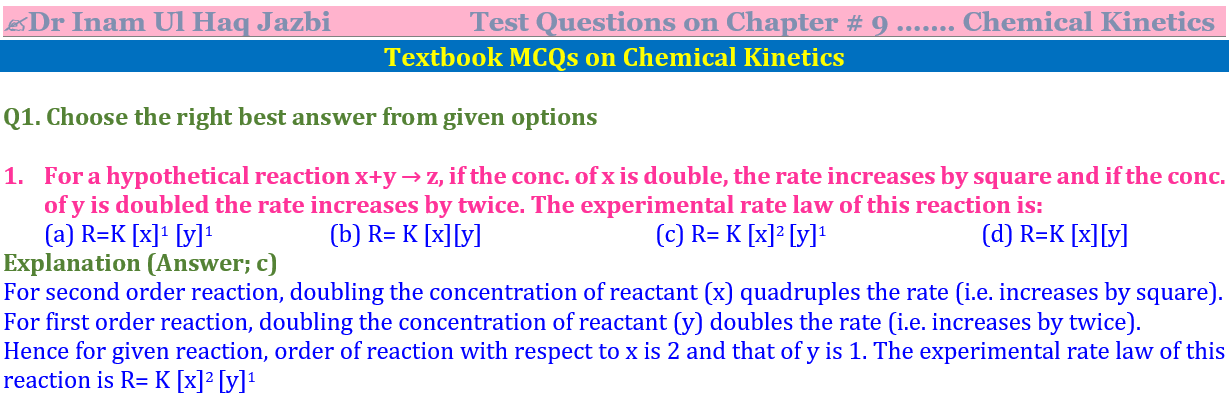
✏️ Text Book and Past Papers MCQs on Chemical Kinetics with Explanatory Answers ✏️
2NO(g) + O2(g) → 2NO2(g)
What happens to the rate when the concentration of NO is doubled?
2C4H6 → C8H12, Rate = K[C4H6]2
✏️ Smart Answers of Model Test Questions XI Chemistry on Chemical Kinetics Chapter # 9 Test # 16✏️
✏️ Smart Answers of Short-Answer Questions on Chemical Kinetics ✏️
Q1. Define (i) Rate of reaction (ii) Velocity of reaction (iii) Order of reaction (iv) Rate constant (v)Catalyst, (vi) activation energy, (vii) threshold energy, (viii) chemical kinetics, (ix) rule of thumb, (x) zero order reaction (xi) MCT (xii) autocatalyst (xiii) promoters (xiv) poisoning of catalyst (xv) inhibitors (xvi) molecularity.
(i) Rate of Reaction ⚡
👉 The rate of reaction is the change in concentration of reactants or products per unit time during a chemical reaction.
It may be defined as decrease in molar concentration of reactants per unit time or increase in molar concentration of products per unit time.
(ii) Velocity of Reaction 🚀
👉 Velocity of reaction is the rate of reaction at a particular moment i.e. specific time (instantaneous rate).
It is obtained by dividing a very small change in concentration (dx) by a very small change in time (dt).
Velocity = dx/dt
(iii) Order of Reaction 🔢
👉 Order of reaction is the sum of the powers (exponents) of concentration terms in the rate law equation of a reaction. It is the number of reacting molecules of substances whose concentrations determine the rate of reaction.
For reaction: xA + yB → Product 👉 Rate = K[A]x [B]y
x = Order w.r.t A
y = Order w.r.t B
x + y = Overall order of reaction
(iv) Rate Constant (K) / Velocity Constant / Specific Rate Constant 📏
👉 Rate constant (K) is the proportionality constant in the rate equation that relates the rate of reaction to reactant concentrations.
K = Rate / ([A]x [B]y)
👉 When concentration of each reactant is 1 mol/dm3, then Rate = K. In this case, K is called specific rate constant.
👉 Its value depends on temperature.
(v) Catalyst 🧪
👉 A catalyst is a substance which alters (increases or decreases) the rate of reaction without undergoing permanent chemical change or quantitative loss.
👉 It can be recovered after the reaction.
👉 The process is called catalysis.
(vi) Activation Energy (Ea) 🔥
👉 Activation energy is the minimum extra energy supplied to reactant molecules to start a reaction.
Ea = Threshold Energy – Average Internal Energy
👉 It is the minimum additional energy required for a successful reaction.
(vii) Threshold Energy (Eth) ⚡
👉 Threshold energy is the minimum energy that reactant (colliding) molecules must possess to collide successfully and form products. Only molecules having energy equal to or greater than Eth can react.
(viii) Chemical Kinetics ⏳
👉 Chemical kinetics is the branch of chemistry that studies the rate of reactions, mechanism of reactions and factors affecting reaction rate.
(ix) Rule of Thumb 📈
👉 As a general rule, for many reactions, the rate of reaction approximately doubles for every 10°C (or 10 K) rise in temperature.
Example:
Increase from 20°C to 80°C (6 intervals of 10°C)
Rate increases = 26 = 64 times
(x) Zero Order Reaction 0️⃣
👉 A zero-order reaction is one whose rate is independent of reactant concentration.
👉 Rate = k
(xi) MCT (Molecular Collision Theory) 💥
👉 MCT states that reactions occur when molecules collide with proper energy and orientation.
Rate of reaction ∝ Number of effective collisions per second.
(xii) Autocatalyst 🔁
When one of the products of a reaction itself acts as a catalyst, it is called an autocatalyst and the phenomenon is called auto-catalysis or self-catalysis.
👉 Initial rate is slow.
👉 Rate increases as product forms.
In redox titration between KMnO₄ and oxalic acid, Mn2+ ions of MnSO₄ (product) catalyze the reaction.
(xiii) Promoters / Activators ➕
👉 Promoters are substances that increase the efficiency of a catalyst though they are not catalysts themselves. They enhance catalytic activity in small amounts.
Examples:
1. Copper or tellurium is a promoter for Ni catalyst in hydrogenation of vegetable oils.
2. K₂SO₄ is a promoter for V₂O₅ catalyst in Contact process for the manufacture of H₂SO₄.
(xiv) Poisoning of Catalyst / Catalytic Poisoning ☠️
👉 When impurities reduce or destroy the activity of a catalyst.
Catalytic poisoning or poisoning of a catalyst is the process of deactivation of a catalyst by impurities. The impurity is called a poison and the deactivated catalyst is said to be poisoned.
👉 It reduces or destroys catalytic activity.
Examples: The compounds of sulphur and arsenic behave as poisons to many metallic catalysts.
(xv) Inhibitors 🛑
👉 An inhibitor is a substance that slows down the rate of reaction.
👉 It increases activation energy or reduces effective collisions.
👉 Also called negative catalyst or retardant.
Example: Glycerine or dilute acids prevent decomposition of H₂O₂.
(xvi) Molecularity 👥
👉 Molecularity is the number of reacting molecules involved in a single elementary step of a reaction.
👉 Always a whole number (1, 2, 3…)
👉 Never zero or fractional.
For a reaction: mA + nB → Product; Molecularity of reaction = m + n
Types:
• Unimolecular → 1 molecule
• Bimolecular → 2 molecules
• Termolecular → 3 molecules
For elementary reactions: Molecularity = Order
Q2. The rate law of the reaction; 2NO + Br₂ → 2NOBr is given as, Rate = K[NO]² [Br₂]. What is the order of reaction: (i) with respect to each reactant? (ii) overall reaction
Reaction → 2NO + Br₂ → 2NOBr
Rate law → Rate = K[NO]²[Br₂]
(i) Order with respect to each reactant 🔢
👉 With respect to NO = 2/second order (Because power of [NO] is 2)
👉 With respect to Br₂ = 1/first order (Because power of [Br₂] is 1)
(ii) Overall Order of Reaction 📊
Overall order = Sum of exponents = 2 + 1 = 3 (third order overall)
Q3. What are the units for the rate constants for zero order, first order, second order and third order reactions?
To find units of rate constant (K), use:
Rate = K [Concentration]ⁿ
Rate unit = mol L⁻¹ s⁻¹ (or M s⁻¹)
✅ Units of Rate Constant for Different Orders 📘✨
(i) Zero Order Reaction (n = 0) 0️⃣
Rate = K
👉 Unit of K = mol L⁻¹ s⁻¹
👉 Same as rate
(ii) First Order Reaction (n = 1) 1️⃣
Rate = K[A]
K = Rate / [A]
👉 Unit of K = s⁻¹
(iii) Second Order Reaction (n = 2) 2️⃣
Rate = K[A]²
K = Rate / [A]²
👉 Unit of K = L mol⁻¹ s⁻¹ (or M⁻¹ s⁻¹)
(iv) Third Order Reaction (n = 3) 3️⃣
Rate = K[A]³
K = Rate / [A]³
👉 Unit of K = L² mol⁻² s⁻¹ (or M⁻² s⁻¹)
ORAlternate Answer
🟦Rate Law and Units of Rate Constant of Various Order of Reactions
📌Rate constant for First order (n = 1) Reaction (Rate = K[A])
✅ Unit of K: s⁻¹ (📌 Independent of concentration unit)
📌Rate constant for Second order (n = 2) Reaction (Rate = K[A][B] or Rate = K[A]²)
✅ Unit of K: M⁻¹ s⁻¹ OR dm³ mol⁻¹ s⁻¹ OR L mol⁻¹ s⁻¹
📌Rate constant for Third order (n =2) reaction (Rate = K[A]²[B] or Rate = K[A] [B]²)
✅ Unit of K:M⁻² s⁻¹ or dm⁶ mol⁻² s⁻¹ or L² mol⁻² s⁻¹
📌Rate constant for Zero order (n = 0) Reaction (Rate = K)
✅ Unit of K: M s⁻¹ OR mol dm⁻³ s⁻¹ OR mol L⁻¹ s⁻¹ (📌 Same as unit of rate)
📌Rate constant for nth order (For order = n) reaction (Rate = K [Concentration]ⁿ) 🔢
✅ Unit of K = M¹⁻ⁿ s⁻¹ OR dm³⁽¹⁻ⁿ⁾ molⁿ⁻¹ s⁻¹ OR L¹⁻ⁿ molⁿ⁻¹ s⁻¹

Q4. Explain the following by give scientific reasons:
🔎 (i) 🪨 Powdered marble reacts faster than marble lump
👉 Powdered CaCO₃ has larger surface area, so more effective collisions occur per unit time.
🔎 (ii) 🥛 Milk sours faster in summer
👉 Higher temperature increases bacterial activity and reaction rate.
🔎 (iii) 🧪 Reactants react faster at high concentration
👉 Higher concentration means more molecules per unit volume, hence more frequent effective collisions.
🔎 (iv) 🌡️ Rate increases with increase in temperature
👉 Increase in temperature increases kinetic energy and number of effective collisions.
🔎 (v) ❄️ Food is preserved in freezers
👉 Low temperature slows down chemical reactions and microbial growth.
🔎 (vi) 💥 Some collisions form products while others do not
👉 Only collisions with sufficient energy (≥ activation energy) and proper orientation are effective.
🔎 (vii) ⚡ Ionic reactions are fast
👉 Ionic compounds in solution are already dissociated into ions, so reaction occurs without bond breaking, leading to rapid reaction.
🔎 (viii) 🔥 Activation energy decreases with increase in temperature
👉 With rise in temperature, more molecules attain required energy, so effective energy barrier appears lower.
🔎 (ix) ☀️ Photochemical reactions are zero order
👉 Their rate depends on intensity of light, not on reactant concentration, hence zero order.
Q5. Differentiate between the following:
⚡ Difference between Rate of Reaction & Velocity of Reaction 🚀
| ⚡ Rate of Reaction | 🚀 Velocity of Reaction |
|---|---|
| ⏳ Change in concentration per unit time | 🕒 Instantaneous rate at a particular moment |
| 📏 Measured over a measurable time interval | 🔬 Measured over an infinitesimally small time (dₓ/dₜ) |
| 📊Rate = [∆Conc]/∆t | ⏱️Velocity of reaction = dₓ/dₜ |
| ⚖️ Represents average rate | ⚡ Represents instantaneous rate |
📏 Rate of Reaction vs Rate / Velocity Constant (K) 📐
| ⚡ Rate of Reaction | 📐 Rate / Velocity Constant (K) |
|---|---|
| ⏳ Change in concentration per unit time | 🧮 Proportionality constant in rate law |
| 📐Mathematically, it is given by: Rate = Change in conc. of 'R' or 'P' / Time taken | 📐Mathematically, it is given by: Velocity constant = Rate of Reaction / Conc. of Reactants |
| 🖊️ Denoted by dₓ/dₜ | 🆔 Denoted by K |
| 🧾 Unit: mol dm⁻³ s⁻¹ (M s⁻¹) | 📏 Unit depends on order of reaction |
| 📉 Decreases as reaction proceeds | 🔒 Remains constant at constant temperature |
| 🧪 Depends on reactant concentration | 🚫 Independent of concentration |
| 🌡️ It directly depends upon temperature | ⏱️ It varies with temperature according to thumb rule |
🧪 Homogeneous vs Heterogeneous Catalyst 🧱
| 🧪 Homogeneous Catalyst | 🧱 Heterogeneous Catalyst |
|---|---|
| Catalyst and reactants are in same phase 🔹 | Catalyst and reactants are in different phases 🔹 |
| Explained by intermediate formation theory 🔬 | Explained by adsorption theory 🧲 |
| High selectivity🎯 | Low selectivity🎲 |
| Difficult to separate and recover ❌ | Easy to separate and reuse ✅ |
| Operates at lower temperature (less than 250°C)❄️ | Requires higher temperature (250 to 500°C) 🔥 |
| High adaptability🔄 | Low adaptability⚙️ |
| High reproducibility🔁 | Low reproducibility⚙️ |
| Lower thermal and pressure stability🌡️⬇️ | Robust at high temperature and pressure🔥🏋️ |
| Reaction occurs throughout the medium 🌊⚗️ | Reaction occurs on catalyst surface 🏭🧪 |
| 📌Example: Acid catalysis in solution🧪💧 | 📌Example: Solid metal catalyst in gas reaction⚙️🔥 |
🔬 Elementary vs 📊 Overall Reaction
| 🔬Elementary Reactions | 📊Complex reactions |
|---|---|
| Only one step reaction🔹 | Two or more steps reactions🔁 |
| No intermediate🚫 | Intermediate(s) formed🧪 |
| Only one transition state⛰️ | Multiple transition states⛰️⛰️⛰️ |
| Overall order usually small🔢⬇️ | Overall order can be large 🔢⬆️ |
| Total and pseudo order = 0,1,2 ⭕ | Can have fractional order (½, 1/3, 3/2) 📐 |
| No side reactions🚫🔀 | Side reactions may occur🔀⚠️ |
| Molecularity = Order of reaction. ⚖️ | Molecularity not defined⚠️ |
| 📌 Example: | 📌 Example: |
| ✅ 2 NO₂ → 2 NO + O₂ (bimolecular, single step) ⚡ | ✅ 2H₂ + O₂ → 2H₂O (via intermediates H & OH) 🔁 |
➕ Positive Catalyst vs Negative Catalyst (Inhibitor) 🛑
| Positive Catalyst or Activators ➕ | Negative Catalyst or Inhibitors 🛑 |
|---|---|
| Increases rate of reaction ⚡ | Decreases rate of reaction 🐢 |
| Lowers activation energy 🔻 | Increases activation energy 🔺 |
| Provides low-energy pathway 🛤 | Blocks or slows reaction pathway 🚧 |
| Increases effective collisions ✅ | Decreases effective collisions ❌ |
| Examples: 📌MnO₂ in KClO₃ decomposition 🧪 2KClO₃ → 2KCl + O₂ (Heterogeneous catalysis) 📌Traces of Cl₂ in decomposition of laughing gas 2N₂O ⇌ 2N₂ + O₂ (at 1000K) |
Examples: 📌Glycerin preventing H₂O₂ decomposition 🥼 2H₂O₂ → 2H₂O + O₂ (Homogeneous catalysis) 📌2% ethyl alcohol prevents chloroform oxidation CHCl₃ + ½ O₂ → COCl₂ + HCl |
Q6. Write down rate expression for following reactions:
1️⃣ ClCOOC₂H₅ → C₂H₅Cl + CO₂ 👉 Rate = K [ClCOOC₂H₅]
2️⃣ N₂O → 2 N₂ + O₂ 👉 Rate = K [N₂O]
3️⃣ 2 CH₃CHO → 2 CH₄ + 2 CO 👉 Rate = K [CH₃CHO]²
4️⃣ 2 NO₂ → 2 NO + O₂ 👉 Rate = K [NO₂]²
5️⃣ N₂O₅ → 2 NO₂ + ½ O₂ 👉 Rate = K [N₂O₅]
6️⃣ 2 A + 3 B → A₂B₃ 👉 Rate = K [A]² [B]³
7️⃣ 2 NO + O₂ → 2 NO₂ 👉 Rate = K [NO]² [O₂]
8️⃣ F₂ + 2 ClO₂ → 2 ClO₂F 👉 Rate = K [F₂] [ClO₂]²
9️⃣ CHCl₃ + ½ O₂ → COCl₂ + HCl 👉 Rate = K [CHCl₃] [O₂]⁽½⁾
🔟 MnO₄⁻ + 5 Fe²⁺ + 8 H⁺ → Mn²⁺ + 5 Fe³⁺ + 4 H₂O 👉 Rate = K [MnO₄⁻] [Fe²⁺]⁵ [H⁺]⁸
1️⃣1️⃣ CH₃COOH + C₂H₅OH → CH₃COOC₂H₅ + H₂O 👉 Rate = K [CH₃COOH] [C₂H₅OH]
Q7. What are Rate Law and Rate Constant. Derive rate expression for a general chemical reaction.
🟥 Rate Law (Reaction Rate Expression)
📏 Rate law is an experimentally determined mathematical expression that shows the quantitative relationship between the rate of a chemical reaction and the molar concentration of reactants. Rate law specifies the rate in terms of reactant concentration with each term raised to some power.
🔹 General form for a reaction: aA + bB → products
Rate Law: Rate = K[A]ᵐ [B]ⁿ
🟥 Rate Constant (K) / Velocity Constant / Specific Rate Constant
🧮 It is the proportionality constant in the rate law.
⚡ Relates rate of reaction to concentrations of reactants (ratio of reaction rate and reactant concentration)
🧮Rate constant = Reaction rate / Product of reactant molar concentrations or K = Rate / [A]ᵡ [B]ᵞ
⚡Rate constant is numerically equal to the rate of reaction when molar concentration of each reactant is 1 mol/dm³ (then rate constant is called specific rate constant)
🔹 Unit of K depends on overall order of reaction:
➡️ Zero order → M s⁻¹
➡️ First order → s⁻¹
➡️ Second order → M⁻¹ s⁻¹
➡️ Third order → M⁻² s⁻¹
🟥 📄 Derivation of Rate Expression for General Reaction
For a general reaction:
xA + yB → products
Rate ∝ [A]ᵡ [B]ᵞ (by Law of Mass Action at constant temperature) ⚖️
Rate = K [A]ᵡ [B]ᵞ [Removing proportionality sign by introducing a constant]
✅ This is the rate law or rate expression for the reaction.
Where:
- K = Rate constant or velocity constant or specific rate constant 🏷️
- [A], [B] = Molar concentrations of reactants A and B 🧪
- m, n = Order of reaction w.r.t A and B 🔢
- Overall order = x + y 🔢
- Depends on concentration, temperature, and catalysts 🌡️🧪
Q8. Differentiate between Elementary and Complex Reactions. What is reaction mechanism? Explain it with the help of example.
⚡ Elementary Reactions vs Complex Reactions 🧪
| Elementary Reaction 🏷️ | Complex (Overall) Reaction 🔹 |
|---|---|
| 1. Single-step reaction 🔹 | Two or more steps elementary reactions 🔁 |
| 2. No intermediate formed 🚫 | Intermediate(s) formed 🧪 |
| 3. Only one transition state ⛰️ | Multiple transition states ⛰️⛰️⛰️ |
| 4. Overall order usually small 🔢⬇️ | Overall order can be large 🔢⬆️ |
| 5. Total and pseudo order = 0,1,2 ⭕ | Can have fractional order (½, 1/3, 3/2) 📐 |
| 6. No side reactions 🚫🔀 | Side reactions may occur 🔀⚠️ |
| 7. Molecularity = Order of reaction ⚖️ | Molecularity not defined ⚠️ |
| 📌 Example: 2NO₂ → 2NO + O₂ (bimolecular, single step) ⚡ |
📌 Example: 2H₂ + O₂ → 2H₂O (via intermediates H & OH) 🔁 |
✨ Reaction Mechanism ⚙️
📏 Definition: It is a step-by-step sequence of elementary reactions by which a complex reaction occurs. It shows the feasible path of molecules during the reaction.
🧬 Shows how reactants transform into products via intermediates.
⚡ Helps explain rate law pathway (kinetics), intermediates and molecularity.
✨ Rate Determining Step (RDS) ⏱
📌 The slowest step in a complex reaction 🐢
📌 Controls the overall reaction rate ⚡
📌 Only reactants in RDS appear in the rate law 🔹
📝 Example of reaction between nitrogen dioxide and carbon monoxide giving nitric oxide and carbon dioxide:
🌟 Equation: NO₂ + CO → NO + CO₂
📌 Experimentally determined rate law: Rate = K[NO₂]²
✨ Observations from Rate Law:
📌 Reaction is 2nd order overall 🔢
📌 Rate depends only on [NO₂], not [CO] ❌
📌 Reaction occurs in multiple steps 🔹
✨ Proposed Two-Steps Mechanism (with two elementary steps) 🧩
📌 Elementary Step 1 (Slow, RDS): NO₂ + NO₂ — (K₁) → NO₃ + NO
📌 Elementary Step 2 (Fast): NO₃ + CO —(K₂)→ NO₂ + CO₂
📌 Overall Reaction: NO₂ + CO → NO + CO₂ (NO₃ being common cancels out)
✨ Basic information about kinetics and molecularity from Proposed mechanism:
- 📌 K₁ and K₂ are the rate constants for elementary reactions 🏷️
- 📌 NO₃ = intermediate (high energy unstable species, not in overall equation) 🌀
- 📌 Step 1 is slow → RDS (rate determining step) ⏱️
- 📌 Molecularity of slow step = 2 (bimolecular) 🔢
- 📌 Rate law depends only on square of NO₂ concentration (2nd order), zero order w.r.t CO ❌
- 📌 CO does not appear in RDS → rate independent of CO ❌
- 📌 Overall Rate Law: K₁[NO₂]² 📈
Q9. What is catalyst? Explain mechanism of catalysis.
🧪 Catalyst
🔹 Definition: A catalyst is a substance that changes the rate of a reaction (increases or decreases) without itself being permanently changed or consumed, and does not appear in the final product. ⚡
🔹 Catalysis: It is the process of speeding up a chemical reaction using a catalyst.
🔹 Reusability: Catalyst can be recovered and used repeatedly ♻️.
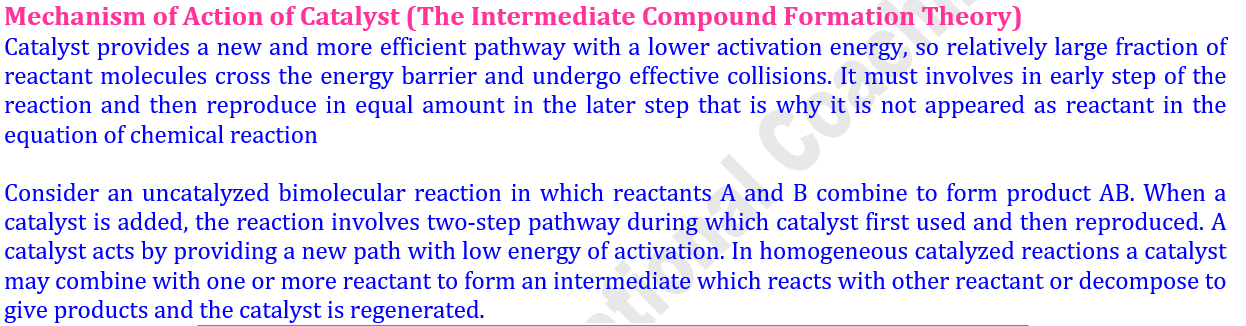
⚡ Mechanism of Catalysis (Intermediate Compound Formation Theory)
🔹 Catalyst provides a new, lower-energy pathway for the reaction → more molecules have enough energy to react 🏃♂️💨.
🔹 It participates in early steps forming intermediate compounds, then is regenerated later, so it doesn’t appear in the overall reaction equation.
📌 Key idea: Lowers activation energy (Eₐ) → increases effective collisions ⚡🧬.

Example
📌 Single-step Uncatalyzed Bimolecular Reaction: A + B —(Slow)→ AB
📌 Two-steps Catalyzed Reaction:
- ➡️ A + Catalyst —(Fast)→ A-catalyst [Intermediate]
- ➡️ A-catalyst + B —(Slow)→ AB + Catalyst ♻️
🔹 Catalyst provides alternate path with lower activation energy → reaction faster.
🔹 In homogeneous reactions, catalyst may temporarily combine with reactants to form intermediates, then is regenerated.
Q10. Define two types of catalyst with examples.
🧪 Two Types of Catalysts
1️⃣ Positive Catalyst (Activator) ⚡
2️⃣ Negative Catalyst / Inhibitor ❌🧪
🟦 Positive Catalyst (simply called as catalyst) ⚡ ⏩
Definition: It is a substance that increases the rate of reaction by lowering the activation energy.
Catalysis: It is the process of accelerating the reaction.
Function: Provides an alternate low-energy path with less Eₐ → more effective collisions 🏃♂️💨.
Examples & Reactions:
📌 Haber Process uses Fe or V catalyst (Heterogeneous catalysis):
N₂ + 3H₂ —(Fe/V)→ 2NH₃
📌 Contact Process uses Pt or V₂O₅ catalyst (Heterogeneous catalysis):
2SO₂ + O₂ —(V₂O₅/Pt)→ 2SO₃
📌 Decomposition of Potassium Chlorate uses MnO₂ catalyst (Heterogeneous catalysis):
2KClO₃ —(MnO₂)→ 2KCl + 3O₂
🟦 Negative Catalyst / Inhibitor / Retarding Catalyst ❌ 🐢
Definition: It is a substance that slows down a reaction by inserting itself between reacting molecules, reducing effective collisions.
Function: Places itself between reactant molecules, reducing effective collisions and retarding the reaction ⚠️.
Examples & Reactions:
📌 Prevention of H₂O₂ decomposition uses glycerine or dilute acids as inhibitor (Homogeneous catalysis):
2H₂O₂ —(Glycerine/Dilute acid)→ 2H₂O + O₂ ❌
📌 Prevention of chloroform oxidation uses 2% ethanol as inhibitor (Heterogeneous catalysis):
CHCl₃ + O₂ —(2%Ethanol)→ COCl₂ + HCl ❌
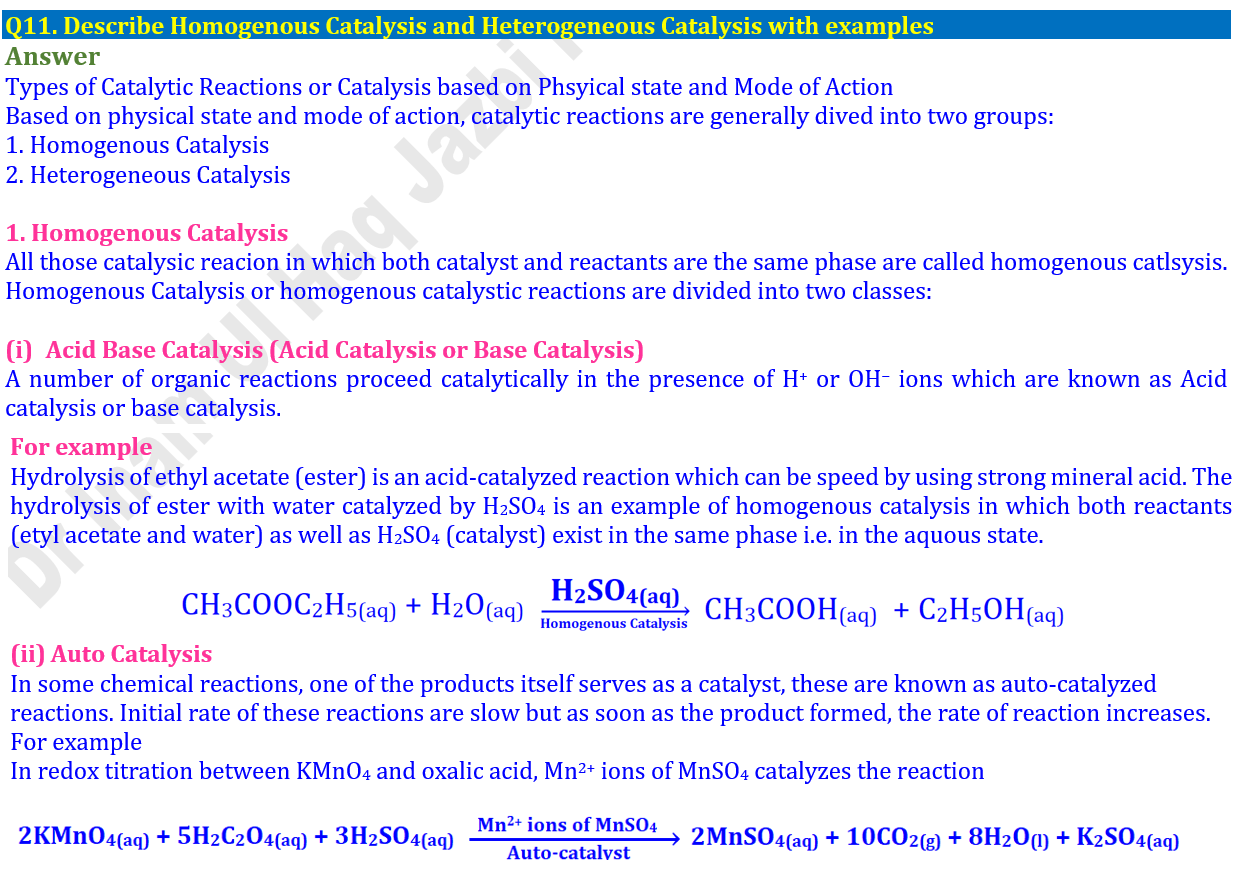
Q11. Describe Homogeneous Catalysis and Heterogeneous Catalysis with examples
🧪 Types of Catalysis based on physical state & mode of action
1️⃣ Homogeneous Catalysis 🌊
2️⃣ Heterogeneous Catalysis 🪨
🟩 Homogeneous Catalysis 🌊
Definition: Catalyst and reactants are in the same phase (all liquid or all gas).
Mechanism: Reaction occurs uniformly in the same medium.
🟩Two Types:
📌(i) Acid/Base Catalysis (Acid Catalysis or Base Catalysis) 🔹
Definition: Uses H⁺ or OH⁻ ions to speed up reactions (especially organic reactions).
Example:
Acid-catalyzed (H₂SO₄) Hydrolysis of ethyl acetate (all species in the same aqueous state)
CH₃COOC₂H₅ + H₂O —(H₂SO₄)→ CH₃COOH + C₂H₅OH
📌(ii) Auto-Catalysis 🔄
Definition: A product acts as a catalyst, rate increases as reaction proceeds.
Example:
Redox titration of KMnO₄ with oxalic acid is catalyzed by Mn²⁺ ions of MnSO₄ (all species in the same aqueous state):
2KMnO₄ + 5H₂C₂O₄ + 3H₂SO₄ —(Mn²⁺)→ 2MnSO₄ + 10CO₂ + 8H₂O + K₂SO₄
🟩 Heterogeneous Catalysis 🪨
Definition: Catalyst is in a different phase from reactants (usually solid catalyst with gas/liquid reactants).
Mechanism: Reactants are adsorbed (chemisorbed) on catalyst surface, lowering activation energy and increasing collision efficiency ⚡🧬.
Examples:
📌Contact Process → Solid catalyst vanadium pentaoxide (V₂O₅)
2SO₂₍g₎ + O₂₍g₎ —(V₂O₅/Pt₍ₛ₎)→ 2SO₃₍g₎
📌Haber Process → Solid iron powder
N₂₍g₎ + 3H₂₍g₎ —(Fe/V₍ₛ₎)→ 2NH₃₍g₎
Q12. What are Enzyme? Write down Mechanism of Enzyme Catalysis
🧬 Enzymes (Biocatalysts)/ Enzyme Catalysis
Definition: These are special proteins that act as catalysts in living systems, speeding up reactions thousands of times faster than inorganic catalysts ⚡.
Enzyme = nature’s super-catalyst 🦸♂️
Specificity: Each enzyme acts on a specific substrate, thanks to its unique active site 🗝️🔒.
Examples: Pepsin (digests proteins), Amylase (digests starch), Lipase (digests fats).
🟩 Mechanism of Enzyme Catalysis
Stepwise Process: A + B + E ⇌ ABE → AB + E
Explanation:
Reactants A & B bind to enzyme E, forming enzyme-substrate complex (ABE) 🧪🔗.
Complex provides a new low-energy pathway → lower activation energy ⬇️⚡.
Product AB forms, enzyme E is regenerated ♻️.
Key Idea: Enzyme works like a “lock and key” 🗝️🔓 — only the correct substrate fits the enzyme’s active site.
🌱 Examples of Enzyme Catalysis
1️⃣ Biological Reactions like Digestion of food:
➡️ Protease → proteins 🥩 → amino acids
➡️ Amylase → starch 🍞 → sugars
➡️ Lipase → fats 🥑 → fatty acids + glycerol
2️⃣ Industrial Processes:
➡️ Fermentation of sugarcane → alcohol 🍹
➡️ Zymase & Invertase in yeast catalyze sugar → ethanol
3️⃣ Modern Laundry Detergent Enzymes (for the removal of stains from fabric):
➡️ Protease → removes protein stains (egg, gravy) 🍳
➡️ Amylase → removes starch stains 🍚
➡️ Lipase → removes oil/fat stains 🛢️
Hydrolytic enzymes break stains into water-soluble substances → easily washed away 💦
✏️ Smart Answers of Long-Answer Questions on Chemical Kinetics ✏️
Q13. Factors Affecting Rate of Chemical Reactions
⚡ Factors Affecting Rate of Chemical Reactions
1. Concentration of reactants (Increases collision frequency by increasing number of molecules)
2. Nature of reactants (For lower Eₐ, rate is high; for higher Eₐ, rate is slow)
3. Surface area of reactants (Increases sites for collision – Heterogeneous reactions)
4. Temperature (Increases pace or velocity of collisions)
5. Radiation or Light (Increases pace of collisions by increasing intensity, lowering Eₐ)
6. Effect of addition of catalyst (Provides alternative reaction path with increased or decreased Eₐ)
7. Pressure of gaseous reactants
1️⃣ Effect of Concentration of Reactants on Reaction Rate
📌 Relation: Rate ∝ product of concentrations of reactants (law of mass action or rate law)
📌 Effect: ↑ concentration → ↑ collision frequency → ↑ reaction rate (except for zero-order reactions) 🧪
📌 Reason: More molecules → more effective collisions per unit time → increases rate
📌 Example: A + B → AB, doubling [A] doubles rate; doubling [A] & [B] quadruples rate 🔁
📌 Nature of Factor: GENERAL FACTOR applicable for all types of reactions
2️⃣ Nature of Reactants
📌 Effect: Depends on activation energy (Eₐ) ⚡
📌 Reason: Lower Eₐ → faster reaction; higher Eₐ → slower reaction
📌 Example: Reactivity of metals with acids varies
3️⃣ Effects of Surface Area of Solid Reactants on Reaction Rate
📌 Effect: ↑ surface area of solid reactant → ↑ reaction rate (heterogeneous reactions only) 🪨➡️💨
📌 Reason: More area → more possibility of molecular collisions
📌 Nature of Factor: SPECIFIC factor only applicable for heterogeneous reactions
📌 Example:
➡️ Powdered zinc with greater surface area reacts faster with HCl than zinc chunks
Zn₍ₛ₎ + 2HCl₍ₐq₎ —(Fast with powder Zn)→ ZnCl₂₍ₐq₎ + H₂₍g₎ (Rapid evolution of bubbles)
➡️ Powdered zinc with greater surface area reacts faster with boiling water than zinc piece
Zn₍ₛ₎ + H₂O₍ₗ₎ —(Fast with powder Zn)→ ZnO₍ₐq₎ + H₂₍g₎ (Rapid evolution of bubbles)
4️⃣ Effect of Temperature on Reaction Rate 🌡️
📌 Effect: ↑ temperature → ↑ kinetic energy → ↑ collision frequency → ↑ rate constant → ↑ rate
📌 Thumb Rule: Rate roughly doubles for every 10°C rise
📌 Reason: More molecules reach activation energy (Eₐ)
📌 Example:
➡️ H₂ + O₂ react slowly at room temp but vigorously at 450°C → H₂O
➡️ Biochemical processes increase with higher temperature and decrease at lower temperature; food spoils faster at room temp and stays fresh longer in a refrigerator
➡️ Gas burners, hot plates, and ovens are used to increase temperature, speeding up slow reactions
5️⃣ Effect of Radiation / Light on Reaction Rate ☀️
📌 Effect: Light energy ↑ → reaction rate ↑
📌 Reason: Photons provide energy to break bonds → more effective collisions
📌 Photochemical Reactions: reactions in presence of sunlight (radiant energy)
📌 Order of Photochemical Reactions: Zero Order as reactant concentration does not influence rate
📌 General Example: Photosynthesis, photography, halogenation of methane, H₂ + Cl₂ reaction
📌 Function of Light: Used for photochemical dissociation of reactant molecules into reactive free radicals
Cl₂ —(Sunlight/ hν)→ 2Cl• ΔH = +242 kJ/mol
📌 Examples:
➡️ Halogenation of Methane: CH₄ + Cl₂ —(Sunlight)→ CH₃Cl + HCl
➡️ Formation of HCl from H₂ + Cl₂ —(Sunlight)→ 2HCl
➡️ Photosynthesis: 6CO₂ + 6H₂O —(Sunlight)→ C₆H₁₂O₆ + 6O₂
📌 Mechanism: Free radical chain reaction
📌 Steps of Mechanism:
➡️ Chain Initiation
➡️ Chain Propagation
➡️ Chain Termination
6️⃣ Catalyst 🧪
📌 Effect: Provides alternative pathway with lower Eₐ → ↑ or ↓ rate
📌 Example: MnO₂ catalyzes KClO₃ decomposition
7️⃣ Pressure of Gaseous Reactants 💨
📌 Effect: ↑ pressure → molecules closer → ↑ collision frequency → ↑ rate
💡 Quick Memory Tips:
General Factors: Concentration, temperature → affect all reactions
Specific Factors: Surface area, radiation, catalyst → apply to certain reactions
Heterogeneous Reactions: Surface area of solid matters
Photochemical Reactions: Often zero-order, light intensity matters
Q2. Explain in terms of collision theory how the reaction rate increases with the rise of temperature
According to collision theory, a chemical reaction occurs only when reactant molecules (particles) collide with sufficient energy (equal to or greater than activation energy) and proper orientation.
When temperature increases, the kinetic energy of molecules increases. As a result:
➡️ Molecules move faster.
➡️ Collision frequency increases (collide more frequently).
➡️ A larger fraction of molecules possess energy equal to or greater than the activation energy.
👉 Therefore, the number of effective collisions increases, which increases the reaction rate.
Although molecules collide billions of times per second, only effective collisions (those with sufficient energy) lead to product formation. At higher temperatures, more molecules can overcome the energy barrier, so the number of effective collisions increases.
Maxwell–Boltzmann Kinetic Distribution curve at Low and High temperature
The Maxwell–Boltzmann distribution curve shows that when temperature rises from T₁ to T₂, the curve flattens and shifts slightly to the right, increasing the area representing molecules with energy ≥ activation energy. This increase in high-energy molecules leads to a higher reaction rate.
Thus, reaction rate increases with temperature because the number of effective collisions increases.

Q3. What is activation energy activated complex? Explain with the help of potential energy diagram. Give its relation with speed of reaction.
🟦Threshold Energy & Effective Collisions
➡️ Only molecules with energy greater than the average kinetic energy can react.
➡️ The minimum energy required for a reaction is called Threshold Energy (Eтʜ).
➡️ Collisions between molecules with energy ≥ Eтʜ are called Effective Collisions.
🟦Activation Energy (Eₐ)
📌 Definition: Activation energy is the extra energy (having average internal energy less than threshold energy) required by reactant molecules to reach threshold energy and form products. (It is the minimum energy that reacting molecules must possess for a collision to be successful and form products). It acts as an energy barrier in a chemical reaction.
Molecules with energy less than Eₐ will collide but won’t react.
📌 Formula: Activation Energy (Eₐ) = Threshold energy (Eтʜ) − Average internal energy
📌 Unit: It is expressed in J/mol, kJ/mol, or kcal/mol.
📌 Condition for Reaction: Molecules must overcome Ea to form products.
🟦 Potential Energy Diagram / Energy Profile 📈
➡️ Shows energy changes as reactants convert to products.
➡️ The hump represents the energy barrier (Eₐ)/potential energy hill.
➡️ Products form only if reactants cross this barrier.
📌 Low Activation Energy (Eₐ): More effective collisions occur. Reaction is fast. ✅
📌 High Activation Energy (Eₐ): Fewer effective collisions occur. Reaction is slow. ⏳
📌 Exothermic reaction: Reactants higher than products.
📌 Endothermic reaction: Reactants lower than products.
🟦 Activated Complex / Transition State ⚡
➡️ The peak of the energy curve in Potential Energy Diagram represents a transition state.
➡️ Molecules are neither reactants nor products and have partial bonds.
➡️ Peak represents the activated complex which is a short-lived, high energy (maximum potential energy) unstable intermediate (unstable arrangement of atoms) formed at the highest energy point (transition state) during a reaction shown by dotted lines.
➡️ It exists momentarily as bonds in reactants are breaking and new bonds in products are forming.
➡️ It is highly unstable and may or may not form products.
➡️ Ea: Activation energy (energy difference between reactants and activated complex).
➡️ Reaction enthalpy (ΔH): The difference in energy between reactants and products is ΔH
🟦Relation of Eₐ with Reaction Rate 🏃♂️
📌 Relation: Reaction rate is inversely related to activation energy:
📌 Higher Eₐ ⇒ fewer molecules can overcome barrier ⇒ slower reaction
📌 Lower Eₐ ⇒ more molecules can overcome barrier ⇒ faster reaction
📌 Temperature effect: Higher temperature → more molecules with energy ≥ Eₐ → faster reaction.

✏️ Smart Solution of Numerical of Chemical Kinetics ✏️
Q1. Nitrogen dioxide is an air pollutant gas. The rate of the decomposition of NO₂ is shown in the following equation:
2NO₂(g) → 2NO + O₂
In an experiment, the initial concentration of NO₂ was found to be 0.35 mol/dm³. What was the initial rate of this reaction if the rate constant at experimental temperature was 1.8 × 10³ dm³ mol⁻¹ s⁻¹.
[Example 9.1, Page 183]
Given
Reaction: 2NO₂ → 2NO + O₂
Reaction order: Second order (indicated by the unit of K, dm³ mol⁻¹ s⁻¹)
Rate constant: K = 1.8 × 10³ dm³ mol⁻¹ s⁻¹
Initial concentration: [NO₂]₀ = 0.35 mol/dm³
Required
Rate of reaction = ?
Rate Law Expression
Rate = K [NO₂]² (for second order reaction)
Rate = 1.8 × 10³ (dm³ mol⁻¹ s⁻¹) (0.35 mol/dm³)²
Rate = 1.8 × 10³ × 0.1225 (mol/dm³ s⁻¹)
Rate = 220.5 or 2.21 × 10² mol.dm⁻³.s⁻¹
✅ Final Answer: Rate = 220.5 or 2.21 × 10² mol.dm⁻³.s⁻¹
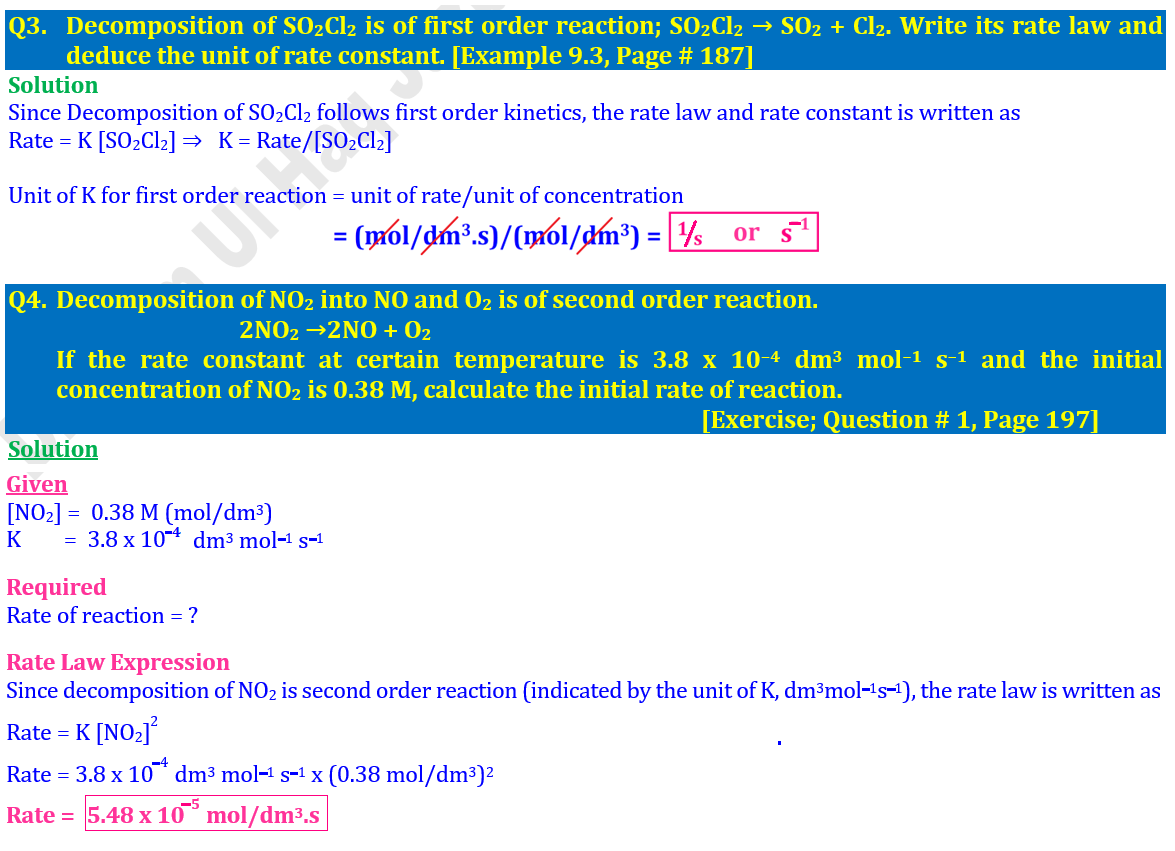
Q2. Decomposition of NO₂ into NO and O₂ is of second order reaction.
2NO₂ → 2NO + O₂
If the rate constant at certain temperature is 3.8 × 10⁻⁴ dm³ mol⁻¹ s⁻¹ and the initial concentration of NO₂ is 0.38 M, calculate the initial rate of reaction.
[Exercise; Question # 1, Page 197]
Given
Reaction: 2NO₂ → 2NO + O₂
Reaction order: Second order (indicated by the unit of K, dm³ mol⁻¹ s⁻¹)
Rate constant: K = 3.8 × 10⁻⁴ dm³ mol⁻¹ s⁻¹
Initial concentration: [NO₂]₀ = 0.38 M (mol/dm³)
Required
Rate of reaction = ?
Rate Law Expression
Rate = K [NO₂]² (for second order reaction)
Rate = 3.8 × 10⁻⁴ dm³ mol⁻¹ s⁻¹ × (0.38 mol/dm³)²
Rate = 5.49 × 10⁻⁵ mol dm⁻³ s⁻¹
✅ Final Answer: Rate = 5.49 × 10⁻⁵ mol dm⁻³ s⁻¹
Q3. The overall rate law for the reaction is R = K[A][B] A + B → C If in an experiment, the initial concentration of A and B was found to be 0.43 M and 0.78 M respectively while the initial rate was 3.8 × 10⁻³ Ms⁻¹. Determine rate constant and mention its unit.
Given
Reaction: A + B → C
Rate law: R = K[A][B]
Initial concentrations: [A] = 0.43 M, [B] = 0.78 M
Initial rate: Rate of reaction = 3.8 × 10⁻³ Ms⁻¹
Required
Rate constant (K) = ?
Rate Law Expression
Rate = K [A][B]
K = Rate / ([A][B])
K = 3.8 × 10⁻³ Ms⁻¹ / (0.43 M × 0.78 M)
K = 3.8 × 10⁻³ s⁻¹ / 0.3354 M
✅ Final Answer: K = 1.13 × 10⁻² M⁻¹ s⁻¹
Q4. The initial rate data in a series of experiments while working on the oxidation of nitric oxide to give nitrogen dioxide is given in the following table. Determine its rate law and find the order of reaction. NO + O₂ → NO₂
| Experiment # | Initial [NO] (M) | Initial [O₂] (M) | Initial rate (M s⁻¹) |
|---|---|---|---|
| 1 | 0.10 | 0.10 | 8 × 10⁻⁴ |
| 2 | 0.10 | 0.20 | 16 × 10⁻⁴ |
| 3 | 0.20 | 0.10 | 16 × 10⁻⁴ |
✴️ Step 1: Order with respect to NO (m)
Compare Experiments 1 & 3 ([O₂] constant at 0.10 M):
[NO] doubles: 0.10 → 0.20 i.e. Times increase in [NO] = 0.20/0.10 = 2 ✅
Rate doubles: 8 × 10⁻⁴ →16 × 10⁻⁴ i.e. Times increase in rate = 16 × 10⁻⁴/8 × 10⁻⁴ = 2 ✅
Order (m): 2ᵐ = 2 ⇒ m = 2/2 = 1
Rate Law: Rate ∝ [NO]¹ ⇒ ✅ first order w.r.t NO ……………….. (1)
✴️ Step 2: Order with respect to O₂ (n)
Compare Experiments 1 & 2 ([NO] constant at 0.10 M):
[O₂] doubles: 0.10 → 0.20 i.e. Times increase in [O₂] = 0.20/0.10 = 2 ✅
Rate doubles: 8 ×10⁻⁴ → 16×10⁻⁴ i.e. Times increase in rate = 16 × 10⁻⁴/8 × 10⁻⁴ = 2 ✅
Order (n): 2ⁿ = 2 ⇒ n = 2/2 = 1
Rate Law: Rate ∝ [O₂]¹ ⇒ ✅ first order w.r.t O₂ ……………….. (2)
✴️ Step 3: Overall Rate Law (obtained by combining eq. (1) and (2)):
Rate ∝ [NO]¹ [O₂]¹ ⇒ Rate = k [NO][O₂] ✅ (Rate law = Rate expression based on experimental data)
Overall order (Sum of exponents of conc. in Rate Law): 1 + 1 = 2 ✅ second-order reaction
✴️ Extra Part: Determine the rate constant (K) with its unit
Rate = K [NO]¹ [O₂]¹
8 × 10⁻⁴ (M s⁻¹) = K [0.1 (M)]¹ [0.1 (M)]¹
8 × 10⁻⁴ (M s⁻¹) = K [0.01 M²]
K = 8 × 10⁻⁴ (M s⁻¹) / 0.01 M² = 0.08 or 8 × 10⁻² M⁻¹ s⁻¹ ✅ (Second order rate constant)
✅ Final Answer: K = 8 × 10⁻² M⁻¹ s⁻¹
Q5. What is Rate Law and order of reaction for given reaction when initial conc. of reactants and initial rates are given: A + B → AB
| Experiment # | Initial [A] (mol dm⁻³) | Initial [B] (mol dm⁻³) | Initial Rate (mol dm⁻³ s⁻¹) |
|---|---|---|---|
| 1 | 0.100 | 0.0050 | 1.25 × 10⁻⁴ |
| 2 | 0.200 | 0.0050 | 2.50 × 10⁻⁴ |
| 3 | 0.100 | 0.010 | 5.0 × 10⁻⁴ |
✴️ Step 1: Order with respect to A (m)
Compare Experiments 1 & 2 ([B] constant at 0.0050 M):
[A] doubles: 0.100 → 0.200 M i.e. Times increase in [A] = 0.200/0.100 = 2 ✅
Rate doubles: 1.25 × 10⁻⁴ → 2.50 × 10⁻⁴ i.e. Times increase in rate = 2.50 × 10⁻⁴ / 1.25 × 10⁻⁴ = 2 ✅
Order (m): 2ᵐ = 2 ⇒ m = 1
Rate Law: Rate ∝ [A]¹ ⇒ ✅ first order w.r.t A ……………….. (1)
✴️ Step 2: Order with respect to B (n)
Compare Experiments 1 & 3 ([A] constant at 0.100 M):
[B] doubles: 0.0050 → 0.010 M i.e. Times increase in [B] = 0.010/0.0050 = 2 ✅
Rate quadruples: 1.25 × 10⁻⁴ → 5.0 × 10⁻⁴ i.e. Times increase in rate = 5.0 × 10⁻⁴ / 1.25 × 10⁻⁴ = 4 ✅
Order (n): 2ⁿ = 4 ⇒ n = 2
Rate Law: Rate ∝ [B]² ⇒ ✅ Second order w.r.t B ……………….. (2)
✴️ Step 3: Overall Rate Law(obtained by combining eq. (1) and (2)):
Rate ∝ [A]¹ [B]² ⇒ Rate = K [A]¹ [B]² ✅ (Rate law = Rate expression based on experimental data)
Overall order (Sum of exponents of conc. in Rate Law): 1 + 2 = 3 ✅ Third-order reaction
✴️ Extra Part: Determine the rate constant (K) with its unit
Rate = K [A]¹ [B]²
1.25 × 10⁻⁴ (mol dm⁻³ s⁻¹) = K [0.100 (mol dm⁻³)]¹ [0.0050 (mol dm⁻³)]²
1.25 × 10⁻⁴ (mol dm⁻³ s⁻¹) = K [2.5 × 10⁻⁶ mol³ dm⁻⁹]
K = 1.25 × 10⁻⁴ / 2.5 × 10⁻⁶ = 50 mol⁻² dm⁶ s⁻¹ ✅ (Third order rate constant)
✅ Final Answer: K = 50 mol⁻² dm⁶ s⁻¹
Q6. The reaction 2NO + Cl₂ → 2NOCl was studied at 25°C, the following results were obtained. [KB-2024] Illustrate the rate law and find the order of reaction. [Exercise; Question # 3, Page 197]
| Experiment # | Initial [NO] (mol dm⁻³) | Initial [Cl₂] (mol dm⁻³) | Initial Rate (mol dm⁻³ s⁻¹) |
|---|---|---|---|
| 1 | 0.1 | 0.1 | 2.52 × 10⁻³ |
| 2 | 0.1 | 0.2 | 5.04 × 10⁻³ |
| 3 | 0.2 | 0.1 | 10.05 × 10⁻³ |
✴️ Step 1: Order with respect to NO (m)
Compare Experiments 1 & 3 ([Cl₂] constant at 0.1 M):
[NO] doubles: 0.1 → 0.2 M i.e. Times increase in [NO] = 0.2 / 0.1 = 2 ✅
Rate quadruples: 2.52 × 10⁻³ → 10.05 × 10⁻³ i.e. Times increase in rate = 10.05 × 10⁻³ / 2.52 × 10⁻³ ≈ 4 ✅
Order (m): 2ᵐ = 4 ⇒ m = 2
Rate Law: Rate ∝ [NO]² ⇒ ✅ Second order w.r.t NO ……………….. (1)
✴️ Step 2: Order with respect to Cl₂ (n)
Compare Experiments 1 & 2 ([NO] constant at 0.1 M):
[Cl₂] doubles: 0.1 → 0.2 M i.e. Times increase in [Cl₂] = 0.2 / 0.1 = 2 ✅
Rate doubles: 2.52 × 10⁻³ → 5.04 × 10⁻³ i.e. Times increase in rate = 5.04 × 10⁻³ / 2.52 × 10⁻³ = 2 ✅
Order (n): 2ⁿ = 2 ⇒ n = 1
Rate Law: Rate ∝ [Cl₂]¹ ⇒ ✅ First order w.r.t Cl₂ ……………….. (2)
✴️ Step 3: Overall Rate Law(obtained by combining eq. (1) and (2)):
Rate ∝ [NO]² [Cl₂]¹ ⇒ Rate = K [NO]² [Cl₂]¹ ✅ (Rate law = Rate expression based on experimental data)
Overall order (Sum of exponents of conc. in Rate Law): 2 + 1 = 3 ✅ Third-order reaction
✴️ Extra Part: Determine the rate constant (K) with its unit
Using Experiment 1 data:
Rate = K [NO]² [Cl₂]¹
2.52 × 10⁻³ = K (0.1)² (0.1)
2.52 × 10⁻³ = K × 0.001
K = 2.52 × 10⁻³ / 0.001 = 2.52 mol⁻² dm⁶ s⁻¹ ✅ (Third order rate constant)
✅ Final Answer: Rate Law = K [NO]² [Cl₂]¹, K = 2.52 mol⁻² dm⁶ s⁻¹, Overall order = 3
Q7. A certain reaction A + B → product gave the following results [KB-2025] On the basis of above results find the rate law and the order of reaction.
| Experiment # | Initial [A] (mol dm⁻³) | Initial [B] (mol dm⁻³) | Initial Rate (mol dm⁻³ s⁻¹) |
|---|---|---|---|
| 1 | 1.0 × 10⁻⁶ | 9.0 × 10⁻⁶ | 1.98 × 10⁻⁴ |
| 2 | 2.0 × 10⁻⁶ | 9.0 × 10⁻⁶ | 3.96 × 10⁻⁴ |
| 3 | 1.0 × 10⁻⁶ | 3.0 × 10⁻⁶ | 6.6 × 10⁻⁵ |
✴️ Step 1: Order with respect to A (m)
Compare Experiments 1 & 2 ([B] constant at 9.0 × 10⁻⁶ M):
[A] doubles: 1.0 × 10⁻⁶ → 2.0 × 10⁻⁶ M i.e. Times increase in [A] = 2 ✅
Rate doubles: 1.98 × 10⁻⁴ → 3.96 × 10⁻⁴ i.e. Times increase in rate = 3.96 × 10⁻⁴ / 1.98 × 10⁻⁴ = 2 ✅
Order (m): 2ᵐ = 2 ⇒ m = 1
Rate Law: Rate ∝ [A]¹ ⇒ ✅ first order w.r.t A ……………….. (1)
✴️ Step 2: Order with respect to B (n)
Compare Experiments 1 & 3 ([A] constant at 1.0 × 10⁻⁶ M):
[B] decreases: 9.0 × 10⁻⁶ → 3.0 × 10⁻⁶ M i.e. Times decrease in [B] = 3 ✅
Rate decreases: 1.98 × 10⁻⁴ → 6.6 × 10⁻⁵ i.e. Times decrease in rate = 1.98 × 10⁻⁴ / 6.6 × 10⁻⁵ ≈ 3 ✅
Order (n): 3ⁿ = 3 ⇒ n = 1
Rate Law: Rate ∝ [B]¹ ⇒ ✅ first order w.r.t B ……………….. (2)
✴️ Step 3: Overall Rate Law
(obtained by combining eq. (1) and (2)):
Rate ∝ [A]¹ [B]¹ ⇒ Rate = K [A][B] ✅ (Rate law = Rate expression based on experimental data)
Overall order (Sum of exponents of conc. in Rate Law): 1 + 1 = 2 ✅ Second-order reaction
✴️ Extra Part: Determine the rate constant (K) with its unit
Using Experiment 1 data:
Rate = K [A]¹ [B]¹
1.98 × 10⁻⁴ = K (1.0 × 10⁻⁶)(9.0 × 10⁻⁶)
1.98 × 10⁻⁴ = K × 9.0 × 10⁻¹²
K = 1.98 × 10⁻⁴ / 9.0 × 10⁻¹² ≈ 2.2 × 10⁷ dm³ mol⁻¹ s⁻¹ ✅ (Second order rate constant)
✅ Final Answer: Rate Law = K [A][B], K ≈ 2.2 × 10⁷ dm³ mol⁻¹ s⁻¹, Overall order = 2
Extra Important Numerical:
The rate constant (K) for the decomposition of nitrogen dioxide is 1.8 × 10⁻³ dm³ mol⁻¹ s⁻¹.
2NO₂(g) → 2NO + O₂ [K.B – 2017, K.B – 2010]
✴️ Part (i): Rate Expression
The decomposition of NO₂ is given as:
2NO₂(g) → 2NO + O₂
The unit of the rate constant, K = 1.8 × 10⁻³ dm³ mol⁻¹ s⁻¹, indicates that this is a **second-order reaction**.
Hence, the **rate law** can be written as:
Rate = K [NO₂]²
✴️ Part (ii): Finding Initial Rate
Given: [NO₂]₀ = 0.75 M, K = 1.8 × 10⁻³ dm³ mol⁻¹ s⁻¹
The initial rate is calculated using the rate law:
Rate = K [NO₂]²
Rate = 1.8 × 10⁻³ × (0.75)²
Rate = 1.8 × 10⁻³ × 0.5625
Rate ≈ 1.01 × 10⁻³ mol dm⁻³ s⁻¹ ✅
✴️ Part (iii): Effect of Doubling Concentration on Rate Constant
New concentration: [NO₂] = 2 × 0.75 M = 1.5 M
Since the reaction is second order, doubling [NO₂] will **quadruple the rate**:
New Rate = 4 × Initial Rate = 4 × 1.0125 × 10⁻³ ≈ 4.05 × 10⁻³ mol dm⁻³ s⁻¹
To verify K remains constant:
Rate = K [NO₂]² ⇒ K = Rate / [NO₂]²
K = 4.05 × 10⁻³ / (1.5)²
K = 4.05 × 10⁻³ / 2.25 ≈ 1.8 × 10⁻³ dm³ mol⁻¹ s⁻¹ ✅
✅ **Observation:** The rate constant K remains the same, independent of concentration, as expected for a second-order reaction.
✅ Final Answers:
- Rate Law: Rate = K [NO₂]²
- Initial Rate at [NO₂] = 0.75 M: 1.01 × 10⁻³ mol dm⁻³ s⁻¹
- Rate Constant after doubling [NO₂]: K = 1.8 × 10⁻³ dm³ mol⁻¹ s⁻¹
Extra Important Numerical:
For the reaction 2NO + O₂ → 2NO₂, the rate of formation of NO₂ is 2.0 × 10³ M s⁻¹.
Calculate rate constant if concentration of both reactants is 0.1 M each.
If concentration of NO is doubled, find:
(i) Reaction rate
(ii) Rate constant
✴️ Part 1: Finding Rate Constant
Given: Rate of formation of NO₂ = 2.0 × 10³ M s⁻¹, [NO] = 0.1 M, [O₂] = 0.1 M
Rate law for the reaction (assume second-order w.r.t NO and first-order w.r.t O₂):
Rate = K [NO]² [O₂]
Rearranging to find K:
K = Rate / ([NO]² [O₂])
K = 2.0 × 10³ / ((0.1)² × 0.1)
K = 2.0 × 10³ / (0.001)
K = 2.0 × 10⁶ M⁻² s⁻¹ ✅
✴️ Part 2: If [NO] is doubled
New [NO] = 2 × 0.1 M = 0.2 M, [O₂] remains 0.1 M
(i) Finding new reaction rate
Rate = K [NO]² [O₂]
Rate = 2.0 × 10⁶ × (0.2)² × 0.1
(0.2)² = 0.04
Rate = 2.0 × 10⁶ × 0.04 × 0.1
Rate = 2.0 × 10⁶ × 0.004
Rate = 8.0 × 10³ M s⁻¹ ✅
✅ Observation: Rate is quadrupled, as expected for second-order dependence on [NO].
(ii) Finding rate constant
Rate constant K remains unchanged for the reaction:
K = Rate / ([NO]² [O₂]) = 8.0 × 10³ / (0.2² × 0.1)
K = 8.0 × 10³ / 0.004 = 2.0 × 10⁶ M⁻² s⁻¹ ✅
✅ Observation: K is independent of concentration, consistent with rate law.
✅ Final Answers:
- Rate Constant: K = 2.0 × 10⁶ M⁻² s⁻¹
- Initial Rate with [NO] = 0.2 M: Rate = 8.0 × 10³ M s⁻¹
- Rate Constant remains: K = 2.0 × 10⁶ M⁻² s⁻¹
Extra Important Numerical:
Q. For a chemical reaction A + 2B → P, the rate of appearance of product is 0.36 mol/dm³·s. Calculate the rate of disappearance of A and B.
✴️ Step 1: Rate of disappearance of A
The rate of reaction is defined as the rate of disappearance of reactants or the rate of appearance of products.
For reactant A, which has a stoichiometric coefficient of 1:
Rate of disappearance of A = Rate of appearance of P × (1/1) = 0.36 mol/dm³·s ✅
✴️ Step 2: Rate of disappearance of B
For reactant B, which has a stoichiometric coefficient of 2:
Rate of disappearance of B = Rate of appearance of P × (2/1) = 0.36 × 2 = 0.72 mol/dm³·s ✅
Extra Important Numerical:
Q. For the reaction C₂H₂ + 2H₂ → C₂H₆, the rate of appearance of C₂H₆ is 0.25 mol/dm³·s. Calculate the rate of disappearance of C₂H₂ and H₂.
✴️ Step 1: Rate of disappearance of C₂H₂
C₂H₂ has a stoichiometric coefficient of 1:
Rate of disappearance of C₂H₂ = Rate of appearance of C₂H₆ × 1 = 0.25 × 1 = 0.25 mol/dm³·s ✅
✴️ Step 2: Rate of disappearance of H₂
H₂ has a stoichiometric coefficient of 2:
Rate of disappearance of H₂ = Rate of appearance of C₂H₆ × 2 = 0.25 × 2 = 0.50 mol/dm³·s ✅