
Prepare for Class IX Chemistry Chapter 3 – Periodicity of Elements with Model Test #7 based on Karachi Board’s 2025 syllabus. Includes MCQs, short questions, and concept-based exam practice for full preparation.




Model Test Questions Chemistry Test # 7 for Chapter # 3 (Periodicity of elements)
Q1. Explain with examples:
i) Doberiener’s law of Triads
ii) Newland’s law of Octaves
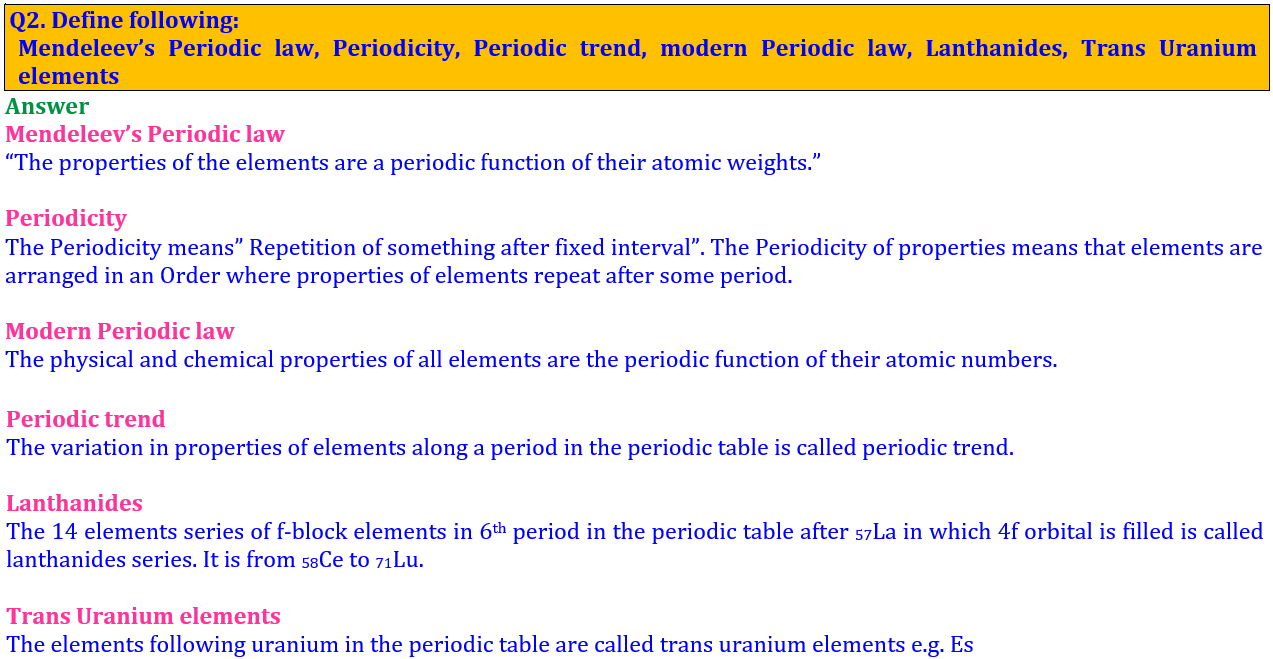
Q2.Define following:
Mendeleev’s Periodic law, Periodicity, periodic trend, modern, periodic law, Lanthanides, Trans Uranium elements
Q3. State Moseley’s Periodic law. What is the basis of periodic classification? Discuss in detail the long form of periodic table.
Q4. Compare the properties of Alkali metals and halogens. Give names of their members.
Q5. Give salient features of group VIIIA. Give their general electronic configuration.
Q6. Write down the names of member elements of Alkaline Earth metals. Give their General characteristics.
Q7. What are lanthanides and actinides? Are they d or f –block elements?
Q8.An element has the atomic number (3 to 20). Give its Electronic configuration. Identify its period and group. Write down three characteristics of the belonging group.
Q9. If an element contains two shells only and its outermost shell contains 5 electrons, then to which group the element belongs in the periodic table? Name the element. Predict its period.
OR
If an element contains two shells only and its outermost shell contains 4 electrons, then to which group the element belongs in the periodic table? Name the element. Predict its period.
Q10. What are transition elements? Give their types. Give their 4 general properties.
Q11. Identify that which halogens exist as gases, liquid and solid?
Q12. Discuss that Mendeleev periodic law provide a base for modern periodic table
Q13. Explain the similarity of chemical and physical properties of elements in the same family
Q14. Distinguish between periods and groups. Explain briefly the periods of modern periodic table.
Q15. Justify that periodicity of properties dependent upon number of protons in an atom?
Q16. Identify the electronic configuration of the following elements; Na, Ca, F, Si
Q17.Determine the demarcation of periodic table in to s, p, d and f blocks.
Q18. Describe the trend of electronegativity within group and period with the help of examples?
Q20. Why Alkaline earth metals shows irregular melting and boiling point?
Q21.Why ionization energy, electron affinity and electronegativity exhibit same trend in period and groups?
Q22. Determine the location of families on periodic table.
Q23. Explain how shielding effect influence the periodic trends?
Q24.Define, give their units, their dependence and periodic variation of the following periodic properties of elements; atomic radii, ionization energy, electron affinity, electronegativity.
Q25. Pick up the correct answer (Multiple choice questions; MCQs)
1. In 1869, Mendeleev put for forward his periodic law about
(a) Atomic number
(b)Chemical properties
(c)Physical properties
(d) Atomic mass
2. The periodic table divided into s, p, d and f blocks based on
(a) Atomic radius
(b) Electronic configuration
(c) Ionization energy
(d) Electron affinity
3.4th and 5th period in periodic table are known as
(a) Short period
(b) Long period
(c) Very long period
(d) Normal period
4. Which one of the following decreases along the period?
(a) Ionization Energy
(b) Atomic Radius
(c) Electronegativity
(d) Electron Affinity
5. The elements of VIIA group are known as:
(a) Lanthanides
(b) Actinides
(c) Halogens
(d) Noble Gases
6. According to Mosley the chemical properties of elements are the periodic function of their:
(a) Atomic Size
(b) Atomic Mass
(c) Atomic Radius
(d) Atomic Number
7. The shielding effect across the period:
(a) Increases
(b) Decreases
(c) Moderate
(d) Remain same
8. The ability to attract shared pair of electron is called:
(a) Electron Affinity
(b) Electronegativity
(c) Ionization Energy
(d) Shielding Effect
9. In group electron affinity values decreases from top to bottom because :
(a) Atomic size normal
(b)Atomic size increases
(c)Atomic size decreases
(d)Atomic size same
10. All Transition Elements are:
(a) Gases
(b) Metals
(c) Nonmetals
(d) Metalloids
11. The rule of triad was introduced by ……
(a) Mendeleev
(b) Newland
(c) Doberiener
(d) Moseley
12. The repetition of properties after regular intervals is called ………
(a) Periodic trend
(b) Periodic variation
(c) Group trend
(d) Periodicity
13.The long form of periodic table contains …….groups.
(a) 16
(b) 18
(c) 8
(d) 2
14.The long form of periodic table contains ……… periods.
(a) 7
(b) 8
(c) 9
(d) 2
15.Mendeleev’s periodic table contained ………… periods.
(a) 7
(b) 8
(c) 10
(d) 12
16.Lother Meyer’s curve included about ……. elements.
(a) Thirty
(b) Forty
(c) Fifty six
(d) Sixty two
17.The only liquid metal is …………
(a) Molybdenum
(b) Gold
(c) Mercury
(d) Bromine
18.According to Mendeleev the properties of elements are the periodic functions of their ………
(a) Atomic mass
(b) Atomic number
(c) Atomic volume
(d) None of them
19. The elements that contain both metallic and non-metallic characteristics are called ………
(a) Metals
(b) Metalloids
(c) Nonmetals
(d) None of them
20. The only liquid non-metal is ……………….
(a) Bromine
(b) Molybdenum
(c) Gold
(d) Mercury
21.The most reactive non-metal is
(a) O
(b) N
(c) Cl
(d) F
22. The most reactive metal is ……
(a) Na
(b) Cu
(c) Fe
(d) Ca
23.The elements of VIA group are known as ……..
(a) Halogens
(b) Chalcogens
(c) Actinides
(d) Lanthanides
24. In the periodic table noble gases are found:
(a) At extreme right
(b) At extreme left
(c) At the bottom
(d) At the center
25. The element with electronic configuration 1s2 is present in the group:
(a) IIA
(b) IIB
(c) VIIIA
(d) IB
26.The element with atomic number 9 is closest to in chemical properties with element of Z:
(a) 27
(b) 37
(c) 47
(d) 53
27. Which one of the following configurations corresponds to alkaline earth metals?
(a) 1s2
(b) 1s2,2s2 2p3
(c) 1s2,2s2 2p6 ,3s2
(d) 1s2,2s2 2p1
28. Which one of the following configurations does not correspond to noble gases?
(a) 1s2
(b) 1s2,2s2 2p6
(c) 1s2,2s2 2p6 ,3s2 3p6
(d) 1s2,2s2 2p5
29. The elements following lanthanum in periodic table are called?
(a) Transuranium elements
(b) Actinides
(c) Transuranic elements
(d) Lanthanides
30. The actinides series of f-block elements is followed by:
(a) Cerium
(b) Actinum
(c) Thorium
(d) Lutetium
31. The elements of VIA group are known as ……..
(a) Chalcogens
(b) Lanthanides
(c) Halogens
(d) Actinides
32. Alkaline earth metals have total ………. Valence electrons.
(a) 3
(b) 2
(c) 1
(d) 4
33. The period three of the modern periodic table contains ………. elements.
(a) 18
(b) 8
(c) 32
(d) 2
34. 1A° = ………
(a) 10–8 cm
(b) 10–10 cm
(c) 10–9 cm
(d) 10–2 cm
35. The most electronegative element in the periodic table is.
(a) F
(b) Cl
(c) Br
(d) I
36. To which family does B belong?
(a) Boron
(b) Carbon
(c) Nitrogen
(d) Fluorine
37.To which family does Si belong?
(a) Boron
(b)Carbon
(c) Nitrogen
(d)Fluorine
38. The incomplete period in the periodic table is ………
(a) 7
(b) 6
(c) 3
(d) 1
39. The longest period is ……. Period.
(a) 4th
(b) 6th
(c) 5th
(d) 7th
40. The longest period contains total ……… elements.
(a) 32
(b) 18
(c) 40
(d) 28
41. Which pair of elements is chemically similar?
(a) F and S
(b) N and O
(c) Na and K
(d) K and Cr
42.Which pair of elements is chemically similar?
(a) F and Cl
(b) N and O
(c) Cu and Ca
(d) K and Cr
43.The second and higher E.A. of atoms is always ……….
(a) Negative
(b) Positive
(c) Zero
(d) None of them
44. 2nd I.P is always … than that of 1st I.P.
(a) Greater
(b) Lesser
(c) Negative
(d) None of them
45. The distance between two atoms of carbon in diamond is 1.54°A giving the radius of carbon atom as.
(a) 0.77°A
(b) 0.2°A
(c) 1.54°A
(d) 0.99°A
46. Which one of the following noble gases should be placed with alkaline earth metals?
(a) At
(b) Ne
(c) He
(d) Xe
47. The period 6 is from?
(a) Rb to Xe
(b) La to Hg
(c) La to Rn
(d) Cs to Rn
48.Which one of the following represents the pair of metalloids?
(a) As and Sb
(b) Mg and Si
(c) B and Al
(d) Ge and C
49. Which one of the following configurations corresponds to alkali metals?
(a) 1s2, 2s2 2p6, 3s2 3p6, 3d10, 4s1
(b) 1s2, 2s2 2p6, 3s2 3p6, 4s1
(c) 1s1
(d) 1s2,2s2 2p1

Answer
Doberiener’s law of Triads
“Central atom of each set of triad has an atomic mass average of the atomic masses of the other two elements.”
For example,
calcium (40), strontium (88) and barium (137) in which atomic mass of strontium is average of atomic masses of calcium and barium.

Newland’s law of Octaves
In 1864, an English industrial chemist John Newland proposed his Law of Octave accordingly:
“If the elements are arranged in the ascending order of their atomic weights, the eighth (8th) element following any given element in the series has nearly same properties as first one i.e. its properties are a kind of repetition of the first.”
For example, Na is the 8th element from Li has similar properties, Mg is the 8th element following Be and has same properties etc.

Answer
Mendeleev’s Periodic law
“The properties of the elements are a periodic function of their atomic weights.”
Periodicity
The Periodicity means” Repetition of something after fixed interval”. The Periodicity of properties means that elements are arranged in an Order where properties of elements repeat after some period.
modern periodic law
The physical and chemical properties of all elements are the periodic function of their atomic numbers.
periodic trend
The variation in properties of elements along a period in the periodic table is called periodic trend.
Lanthanides
The 14 elements series of f-block elements in 6th period in the periodic table after 57La in which 4f orbital is filled is called lanthanides series. It is from 58Ce to 71Lu.
Trans Uranium elements
The elements following uranium in the periodic table are called trans uranium elements e.g. Es

Answer
Atomic number is a fundamental property of an atom because it increases regularly element to element and is fixed for every elements. Atomic number also provides the electronic configuration of elements of periodic table.
A British physicist, Henry Moseley in 1914 showed that atomic number (number of protons) of an atom is the fundamental and basic property. The modern periodic table is the result of discovery of atomic number by Moseley in 1914. Based on the concept of atomic number Bohr, Werner and Bury proposed the modern periodic law which states that:
The physical and chemical properties of all elements are the periodic function of their atomic numbers.
Basis of Classification
The periodic classification of elements is based on periodicity, due to which the elements having similar properties are repeated at regular intervals. As atomic number is related to the number of protons in an atom, so the real basis of periodicity of properties is due to recurrence of identical valence shell electronic configuration of the next element in the same group.
The periodic table is a tabular form of the known elements in which elements are placed in the increasing order of their atomic number or electronic structure (configuration) so that many chemical properties vary regularly across the table.
The modern periodic table based on Mosley’s Modern Periodic Law grounded on periodicity adopted by IUPAC in 1984 is also known as Bohr’s Long Form of Periodic Table (because it contains 16 groups or 18 vertical columns rather than 8 and 7 periods instead of 12).

Answer
Difference between Alkali Metals and Halogens


Answer
Group VIIIA or Zero Group (Inert or Noble Gases)
Members
This group includes helium (He), neon (Ne), argon (Ar), krypton (Kr), xenon (Xe) & radon. Radon (radioactive)
General Characters
1. They are monoatomic, diamagnetic and low boiling point colourless gases.
2. They are have ns2 np6 valency shell configuration (where n = 1 – 6) i.e. they have 8 valence electrons (except helium which has only two valence electrons i.e. 1s2).
3. They have complete valence shell i.e. an octet or duplet (He) of electrons in their valence shell. They are exceptionally stable due to completely filled valence shell.
4. They are chemically inert or non-reactive due to completely filled outer shell

Answer
Members
This group comprises of Beryllium (Be), magnesium (Mg), calcium (Ca), strontium (Sr), barium (Ba) and radium (Ra). Radium is radioactive.
General Characters
1. They are less reactive and less electropositive than alkali metals, a bit harder having relatively high melting and boiling points than the alkali metals.
2. They have ns2 valency shell electronic configuration i.e. contain two valence electrons and are divalent.
3. They lose their two valence electron on reaction to form divalent positive ion (M2+).
4. They are reducing agent due to the low I.P.
5. They form ionic bond except Be and Mg.
6. They show irregular densities and melting and boiling points.

Answer
Lanthanides
The 14 elements series of f-block elements in 6th period in the periodic table after 57La in which 4f orbital is filled is called lanthanides series. It is from 58Ce to 71Lu.
Actinides
The 14 elements series of f-block elements in 7th period in the periodic table after 89Ac in which 5f orbital is filled is called actinides series. It is from 90Th to 103Lr.
Lanthanides and actinides are f-block elements in which f-orbital is progressively filled.
Q8. An element has the atomic number (3 to 20). Give its Electronic configuration. Identify its period & group.
Answer


Since element contains only two shells, its period is 2.
Since element has 5 valence electrons, its group is VA.
The element present in 2nd period belonging to group VA is nitrogen with Z = 7.
OR
Since element contains only two shells, its period is 2.
Since element has 4 valence electrons, its group is IVA.
The element present in 2nd period belonging to group IVA is carbon with Z = 6.

Answer
Definition of Transition Elements
The elements in which besides the valence shell, penultimate shell is also incomplete i.e. in which electrons are in the process of occupying d or f sub-shells (orbitals) are called transition elements.
Characteristics of Transition Elements
1. They all are metals.
2. They show variable valencies (forming more than one type of ions)
e.g. Cu1+, Cu2+, Fe2+, Fe3+ etc.
3. Their valence shells are incomplete.
4. They form coloured compounds
e.g. ferric salts are brown.
5. They all are paramagnetic except Zn, Cd, Hg.
Classification of Transition Elements
They consist of following types:
1. Outer Transition Elements
The elements of sub-group B from IB, IIB, IIIB to VIIIB are called Outer Transition Elements which are characterized by filling of penultimate d-sub-shell with outer s-sub-shell.
They have partially filled d-sub-shell. That is why they are called d-block elements.
They consist of four series of 10 elements each.
2. Inner Transition Elements
The elements which are characterized by filling of penultimate f sub-shell with outer s-sub-shell having partially filled f sub-shell are called Inner Transition Elements or f-block elements.
They are placed at the bottom of the periodic table.
They consist of two series of 14 elements each.


Answer
In 1869 Mendeleev proposed a periodic law on the basis of physical and chemical properties empirically. which states that
“The properties of the elements are a periodic function of their atomic weights.”
Features of Mendeleev’s Table
The Mendeleev’s periodic table consisted of 8 vertical columns called groups (i.e. group I to VIII) containing similar elements and 12 horizontal rows called Series or Periods having dissimilar elements. The group number indicates the highest valency of the element of that group. In certain cases Mendeleev left gaps, which modified by Moseley.
Atomic number is a fundamental property of an atom because it increases regularly element to element and is fixed for every elements. Atomic number also provides the electronic configuration of elements of periodic table. It was noticed in arrangement of elements that atomic number increases from left to right in a horizontal row and properties of elements were found repeating after regular intervals. Due to this reason elements of same properties and same electronic configuration are placed in same group.

Answer
Elements in the same group have same valence shell electronic configuration. Since chemical properties of elements depend on number of valence electrons or valence shell electronic configuration, hence elements in the same group have same chemical properties. For example all elements of group IA have same ns1 configuration so they have same chemical properties i.e. they all are metals, showing fixed valency of 1, forming ionic bond etc.


First period (shortest period)
1. This period contains only two elements Hydrogen (H) and Helium (He).
2. This period corresponds to filling up of K-shell.
Second and Third Period (Short Period; Period 2 and 3 are Short Periods as each contains 8 elements)
1. Each periods contain eight elements (3Li to 10Ne and 11Na to 18Ar respectively)
2. In these Periods L and M shells are being filled by electrons respectively.
3. Second period contains Li, Be, B, C, N, O,F and Ne.
4. Third period contains Na, Mg, Al, Si, P,S, Cl, and Ar.
Fourth and Fifth Period (Long Period; Period 4 and 5 are Long Periods as each contains 18 elements)
1. Each period contain 18 elements (19K to 36Kr and 37Rb to 54Xe respectively).
2. In these periods N and O shells are being filled by electrons.
3. Fourth period starts from Potassium (K) and ends on Krypton (Kr).
4. Fifth period starts from Rubidium (Rb) and ends on Xenon (Xe).
Sixth Period (Longest Period)
1. This period contains 32 elements.
2. This periods starts from Cesium (Cs) and ends with Radon (Rn) (i.e. 55Cs to 86Rn).
3. This period contains a group of 14 elements at the bottom called as Lanthanides.
Seventh Period (Incomplete Period)
1. This period is considered as incomplete (as to date about 112 elements have been discovered)
2. This period starts from Francium (Fr)
3. This period contains a group of 14 elements at the bottom known as Actinides.

Answer
The Periodicity means” Repetition of something after fixed interval”. The Periodicity of properties means that elements are arranged in an Order where properties of elements repeat after some period.
The periodic classification of elements is based on periodicity, due to which the elements having similar properties are repeated at regular intervals. As atomic number is related to the number of protons in an atom, so the real basis of periodicity of properties is due to recurrence of identical valence shell electronic configuration of the next element in the same group.
According to Modern Periodic Law, the properties of elements are periodic function of their atomic number which in turn is related to electronic configuration. The electronic configuration gives relationship between valency, I.P, E.A, Atomic Volume, E.N., Density, Metallic Character, M.P and B.P etc.

Answer
The periodic table has been divided into following 4 blocks on the basis of electronic configuration:
1. Representative Elements (s-block and p-block elements)
2. Noble Gases
3. Outer transition elements (d-block Elements)
4. Inner transition elements (f-block Elements)
1. Representative Elements
Definition
The elements of sub-group A are called Main group or Normal or Major or Representative Elements as the properties of these elements are represented by valence electrons. s-block and p-block elements except inert gases are known as representative elements. They form group IA to VIIA and are present at left and right side of the periodic table. Their general valence shell electronic configuration of ns1, ns2 to ns2 np5 (ns1-2 to ns2 np1-5).
Characters
1. They consist of some metals (IA and IIA Groups, some elements of IIIA group, Pb, Bi etc.), all non-metals and metalloids (B, Si, Ge, As, Sb, Se, Te).
2. Some elements are diamagnetic and some are paramagnetic.
(a) s-block Elements
The elements in which outer electrons enter into s-orbital having ns1-2 (i.e. ns1 to ns2) valence shell configuration are called s-block elements. They form group IA and IIA of periodic table found at its far left side.
(b) p-block Elements
The elements in which outer electron enters into p-orbitals having ns2 np1-6 valence shell configuration are called p-block elements. They from Group IIIA to Group VIIIA of the periodic table and are located at the extreme right of the periodic table. There are total 30 elements in six sub-groups of p-block including noble gases except helium.
2. Nobel gases
1. They are colourless, unreactive and diamagnetic gases.
2. They are place in zero or VIIIA group
3. Their valence shell configuration ns2 np6
4. They are exceptionally stable.
3. d-Block Elements or Outer Transition Elements
Definition
The elements of sub-group B in which last electron enters into (n–1)d-orbitals( in their atomic state or ionized state or in their common oxidation states) are called d-block elements. Their valence shell electronic configuration (n–1)d1-10, ns2
Characters
They all are metals characterized by their variable valencies, forming coloured compounds and their ability to form complex ions. they show common oxidation state.
Sub-division
The outer transition (d-block) elements consist of following 4 series of 10 elements each:
4. Inner Transition Elements
The elements in which last electron enters into inner (n–2)f-orbitals i(n their atomic state or ionized state or in their common oxidation states) are called f-block elements. Their valence shell electronic configuration (n–2)f1-14, (n–1)d1, ns2
Sub-division
f-block consists of two series of 14 elements each namely Lanthanide Series and Actinide Series.
(a) Lanthanides (4f) series in 6th period; following 57La and it is from 58Ce to 71Lu
(b) Actinides (5f) series in 7th period; following 89Ac and it is from 90Th to 103Lr