

Welcome to InamJazbi's Learn Chemistry! 🧪
Whether you're just starting out or looking to deepen your understanding of chemistry, you're in the right place! Here, we break down complex topics like Chemical Reactivity, reaction rates, and everything in between in a fun, easy-to-understand way.
Get ready to explore the fascinating world of atoms, molecules, and reactions. Let’s make chemistry exciting and accessible! 🌟
Stay tuned for expert tips, quizzes, and interactive lessons. Let’s dive in and learn chemistry together! 🚀
📘 Model Test Questions IX Chemistry 📘
on Chemical Reactivity for Chapter #8
✏️ Short Answer-Questions ✏️
Q1. What are Alkali metals? Write names, symbols and general configuration of alkali metals? Explain why alkali metals do not exist free in nature?
Q2. What are Alkaline Earth Metals? Write names, symbols and general configuration of Alkaline earth metals?
Q3. What are Halogens? Write names, symbols and general configuration of Halogens?
Q4. What are metalloids? Write names and symbols of any 5 metalloids.
Q5. Define Cation and anion with examples.
Q6. Differentiate between metal and non-metals.
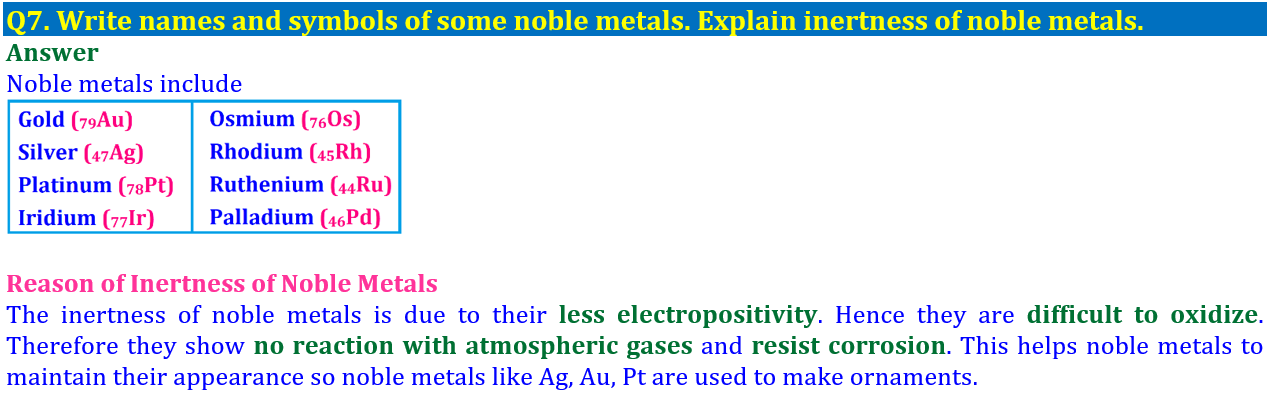
Q7. Write names and symbols of some noble metals. Explain inertness of noble metals.
Q8. Explain electronegative character of non-metals.
Q9. Explain importance of Silver and Gold.
Q10. Arrange the following Halogen Acids in increasing order of their Acidic strength: HBr, HCl, HI, HF
Q11. Define Moh Scale. What are Soft and Hard Metals?
Q12. Identify the elements as metals, non-metals and metalloids from the following: C, Ca, Sb, S, Sr, Se, K, P, N, Ba, Ge, I, Al, B, As
Q13. Explain Flame test.
✏️ Long Answer-Questions ✏️
Q1. Differentiate between sodium and iron as soft and hard metal.
Q2. Explain Electropositive character of metals.
Q3. Explain the position of sodium and Magnesium in periodic table and its importance.
Q4. Discuss the reactivity of Halogens.
Q5. Explain the experiment to test CO₃²⁻, Cl⁻ and I⁻ ions.
Q6. Explain the experiment to test Zn²⁺, Mg²⁺, NH₄⁺, Ca²⁺ and Ba²⁺ ions.
Q7. Compare the reactivity of Alkali and Alkaline Earth Metals.
✏️ Multiple Choice Questions on Chapter 8 Chemical Reactivity ✏️
1. Which one metal belongs to alkaline earth metals?
(a) B
(b) Bi
(c) Br
(d) Ba
✔ Correct: (d) Ba → Barium is an alkaline earth metal in Group 2.
2. Which one is Barium
(a) B
(b) Bi
(c) Br
(d) Ba
✔ Correct: (d) Ba → Symbol Ba stands for Barium.
3. Chlorine can be displaced by _________
(a) F
(b) Br
(c) I
(d) At
✔ Correct: (a) F → Fluorine is more reactive and displaces chlorine.
4. Which one is strong acid?
(a) HF
(b) HBr
(c) HI
(d) HCl
✔ Correct: (b) HBr → Hydrobromic acid is stronger than HF and HCl.
5. Which halogen exists as liquid?
(a) F₂
(b) Br₂
(c) I₂
(d) Cl₂
✔ Correct: (b) Br₂ → Bromine is the only halogen liquid at room temperature.
6. Non-metals of this groups are gases
(a) VI-A
(b) VII-A
(c) VIII-A
(d) VIII-B
✔ Correct: (b) VII-A → Halogens include F₂, Cl₂ which are gases.
7. Which one is metalloid?
(a) Br
(b) Se
(c) S
(d) Sr
✔ Correct: (b) Se → Selenium shows metalloid properties.
8. Which one of the following act as oxidizing agent?
(a) Be
(b) Mg
(c) Na
(d) Cl
✔ Correct: (d) Cl → Chlorine gains electrons, acts as oxidizing agent.
9. Which gas can turn lime water milky?
(a) O₂
(b) NO₂
(c) CO₂
(d) N₂
✔ Correct: (c) CO₂ → Forms CaCO₃ precipitate turning lime water milky.
10. Which compound is known as lunar caustic?
(a) KNO₃
(b) AgNO₃
(c) NaOH
(d) NaNO₃
✔ Correct: (b) AgNO₃ → Silver nitrate is called lunar caustic.
✏️ Smart Answers of Model Test Questions on Chemical Reactivity ✏️
✏️ Smart Answers of Short Answer-questions ✏️
Q1. What are Alkali metals? Write names, symbols and general configuration of alkali metals?
Explain why alkali metals do not exist free in nature?
Answer
✨ Definition of Alkali metals ✨
🧪 Alkali metals are the elements of Group IA of the periodic table.
⚡ They are highly electropositive, metallic, and very reactive.
☢️ Francium (last element) is radioactive.
📋 Names and Symbols :
🔹 Lithium (Li)
🔹 Sodium (Na)
🔹 Potassium (K)
🔹 Rubidium (Rb)
🔹 Cesium (Cs)
🔹 Francium (Fr)
🧠 General electronic configuration:
➡️ ns¹ (n = number of orbit ranges 2–7)
🚫 Reason of non-existence in free state:
⚡ Because alkali metals have low ionization energy, they easily lose one electron and react quickly.
🌍 Hence, they are found only in combined forms like halides, oxides, nitrates, silicates, and borates, not as free elements.
✅ In short:
Highly reactive metals 🔥 → always combined in nature 🌍
✨ Definition of Alkali metals ✨
🧪 Alkali metals are the elements of Group IA of the periodic table.
⚡ They are highly electropositive, metallic, and very reactive.
☢️ Francium (last element) is radioactive.
📋 Names and Symbols :
🔹 Lithium (Li)
🔹 Sodium (Na)
🔹 Potassium (K)
🔹 Rubidium (Rb)
🔹 Cesium (Cs)
🔹 Francium (Fr)
🧠 General electronic configuration:
➡️ ns¹ (n = number of orbit ranges 2–7)
🚫 Reason of non-existence in free state:
⚡ Because alkali metals have low ionization energy, they easily lose one electron and react quickly.
🌍 Hence, they are found only in combined forms like halides, oxides, nitrates, silicates, and borates, not as free elements.
✅ In short:
Highly reactive metals 🔥 → always combined in nature 🌍
Q2. What are Alkaline Earth Metals? Write names, symbols and general configuration of Alkaline earth metals?
Answer
✨ Definition of Alkaline earth metals ✨
🧪 Alkaline earth metals are the elements of Group IIA of the periodic table.
⚡ They are electropositive, metallic, and reactive elements.
☢️ Radium (the last element) is radioactive.
📋 Names and Symbols Alkaline earth metals:
🔹 Beryllium (Be)
🔹 Magnesium (Mg)
🔹 Calcium (Ca)
🔹 Strontium (Sr)
🔹 Barium (Ba)
🔹 Radium (Ra)
🧠 General electronic configuration:
➡️ ns² (n = number of orbit ranges 2–7)
✅ In short:
Group IIA metals ⚙️ | Reactive nature 🔥 | Two valence electrons 🧠
✨ Definition of Alkaline earth metals ✨
🧪 Alkaline earth metals are the elements of Group IIA of the periodic table.
⚡ They are electropositive, metallic, and reactive elements.
☢️ Radium (the last element) is radioactive.
📋 Names and Symbols Alkaline earth metals:
🔹 Beryllium (Be)
🔹 Magnesium (Mg)
🔹 Calcium (Ca)
🔹 Strontium (Sr)
🔹 Barium (Ba)
🔹 Radium (Ra)
🧠 General electronic configuration:
➡️ ns² (n = number of orbit ranges 2–7)
✅ In short:
Group IIA metals ⚙️ | Reactive nature 🔥 | Two valence electrons 🧠
Q3. What are Halogens? Write names, symbols and general configuration of Halogens?
Answer
🧪 Halogens are the elements of Group VIIA of the periodic table.
⚡ They are highly electronegative, non-metallic, and very reactive elements.
☢️ The last element, astatine, is radioactive.
📋 Halogens include:
🔹 Fluorine (F) – pale yellow gas 🌫️
🔹 Chlorine (Cl) – greenish-yellow gas 💨
🔹 Bromine (Br) – reddish-brown liquid 💧
🔹 Iodine (I) – grey solid / violet vapor 💜
🔹 Astatine (At) – radioactive ☢️
🧠 General electronic configuration:
➡️ ns² np⁵
✅ In short:
Group VIIA elements 🔬 | Very reactive ⚠️ | Need one electron to complete octet 🧠
🧪 Halogens are the elements of Group VIIA of the periodic table.
⚡ They are highly electronegative, non-metallic, and very reactive elements.
☢️ The last element, astatine, is radioactive.
📋 Halogens include:
🔹 Fluorine (F) – pale yellow gas 🌫️
🔹 Chlorine (Cl) – greenish-yellow gas 💨
🔹 Bromine (Br) – reddish-brown liquid 💧
🔹 Iodine (I) – grey solid / violet vapor 💜
🔹 Astatine (At) – radioactive ☢️
🧠 General electronic configuration:
➡️ ns² np⁵
✅ In short:
Group VIIA elements 🔬 | Very reactive ⚠️ | Need one electron to complete octet 🧠
Q4. What are metalloids? Write names and symbols of any 5 metalloids.
Answer
🧪 Metalloids are elements that show dual character ⚖️.
They have properties of both metals and non-metals, and often show intermediate behavior between them.
📋 Examples of metalloids (any 5):
🔹 Boron (B)
🔹 Silicon (Si)
🔹 Germanium (Ge)
🔹 Arsenic (As)
🔹 Antimony (Sb)
✅ In short:
Metalloids = mix of metal + non-metal properties 🔬✨
🧪 Metalloids are elements that show dual character ⚖️.
They have properties of both metals and non-metals, and often show intermediate behavior between them.
📋 Examples of metalloids (any 5):
🔹 Boron (B)
🔹 Silicon (Si)
🔹 Germanium (Ge)
🔹 Arsenic (As)
🔹 Antimony (Sb)
✅ In short:
Metalloids = mix of metal + non-metal properties 🔬✨
Q5. Define Cation and Anion with examples.
Answer
🔹 Cation ➕
A cation is a positively charged ion formed when an electropositive metal atom (except NH₄⁺ etc.) loses one or more electrons ⚡.
📌 Examples:
➡️ Sodium loses 1 electron → Na⁺ (monovalent cation)
➡️ Magnesium loses 2 electrons → Mg²⁺ (divalent cation)
➡️ Aluminium loses 3 electrons → Al³⁺ (trivalent cation)
🔹 Anion ➖
An anion is a negatively charged ion formed when an electronegative non-metal atom gains one or more electrons 🔋.
📌 Examples:
➡️ Chlorine gains 1 electron → Cl⁻ (univalent chloride ion)
➡️ Oxygen gains 2 electrons → O²⁻ (bivalent oxide ion)
➡️ Nitrogen gains 3 electrons → N³⁻ (trivalent nitride ion)
✅ In short:
Loss of electrons ➜ Cation ➕
Gain of electrons ➜ Anion ➖
🔹 Cation ➕
A cation is a positively charged ion formed when an electropositive metal atom (except NH₄⁺ etc.) loses one or more electrons ⚡.
📌 Examples:
➡️ Sodium loses 1 electron → Na⁺ (monovalent cation)
➡️ Magnesium loses 2 electrons → Mg²⁺ (divalent cation)
➡️ Aluminium loses 3 electrons → Al³⁺ (trivalent cation)
🔹 Anion ➖
An anion is a negatively charged ion formed when an electronegative non-metal atom gains one or more electrons 🔋.
📌 Examples:
➡️ Chlorine gains 1 electron → Cl⁻ (univalent chloride ion)
➡️ Oxygen gains 2 electrons → O²⁻ (bivalent oxide ion)
➡️ Nitrogen gains 3 electrons → N³⁻ (trivalent nitride ion)
✅ In short:
Loss of electrons ➜ Cation ➕
Gain of electrons ➜ Anion ➖
Q6. Differentiate between Metals and Non-metals.
Answer
Difference between Metals and Non-metals
Difference between Metals and Non-metals
| Metals 🔵 | Non-metals 🟢 |
| Physical Properties | |
| Solids | Solids, liquids and gases |
| Lustrous ✨, Sonorous 🔔, Malleable and ductile | Non-lustrous, non-sonorous, non-malleable and non-ductile ❌ |
| Strong, hard, high density 💪 | Weak/moderate, low density ⚖️ |
| Good conductors of heat and electricity ⚡ | Poor conductors of heat and electricity ❌ |
| High melting and boiling points 🔥 | Low melting and boiling points ❄️ |
| Chemical Properties | |
| React with O₂ → basic oxides (Li₂O, Na₂O, K₂O, MgO) | React with O₂ → acidic (CO₂, SO₃, NO₂) / neutral oxides (H₂O, CO, N₂O, NO) |
| React with H₂ → ionic hydrides (NaH etc.) | React with H₂ → covalent hydrides (HCl etc.) |
| React with dilute acids → H₂ gas | Do not react with dilute acids ❌ |
| React with water → oxides / hydroxides 💧 | Usually do not react with water ❌ |
| Electropositive, form cations ➕ | Electronegative, form anions ➖ |
| Reducing agents (electron donors) | Oxidizing agents (electron acceptors) |
| Examples: Li, Na, K, Mg, Al, Fe, Cu, Zn, Ag, Au etc. | Examples: H, O, N, F, Cl, C, S, P, Br, I etc. |
Q7. Write names and symbols of some noble metals. Explain inertness of noble metals.
Answer
◆ Noble Metals 🟨
📋 Names & Symbols:
➡️ Silver → ₇₉Ag 🥈
➡️ Gold → ₄₇Au 🥇
➡️ Platinum → ₇₈Pt ⚪
➡️ Irridium → ₇₇Ir 💎
➡️ Osmium → ₇₆Os 🖤
➡️ Rhodium → ₄₅Rh 🌟
➡️ Rutheneium → ₄₄Ru 🔹
➡️ Palladium → ₄₆Pd ✨
📋 Names & Symbols:
➡️ Silver → ₇₉Ag 🥈
➡️ Gold → ₄₇Au 🥇
➡️ Platinum → ₇₈Pt ⚪
➡️ Irridium → ₇₇Ir 💎
➡️ Osmium → ₇₆Os 🖤
➡️ Rhodium → ₄₅Rh 🌟
➡️ Rutheneium → ₄₄Ru 🔹
➡️ Palladium → ₄₆Pd ✨
⚕ Reason for Inertness
Noble metals have low electropositivity ⚡
Hard to oxidize, so they don’t react with air or moisture 🌬️💧
Resist corrosion → maintain shine ✨
✅ That’s why Ag, Au, Pt are used in jewelry 💍
Noble metals have low electropositivity ⚡
Hard to oxidize, so they don’t react with air or moisture 🌬️💧
Resist corrosion → maintain shine ✨
✅ That’s why Ag, Au, Pt are used in jewelry 💍
Q8. Explain electronegative character of non-metals
Answer
⚡ Electronegative Character of Non-Metals
Definition:
The tendency of a non-metal to accept electrons and form an anion ➖ is called electronegative character.
💡 Non-metals easily gain electrons to complete their octet.
🧪 Reason of High Electronegative Character of Halogens:
Halogens are very electronegative because they readily accept electrons 🧲. This makes them highly reactive ⚡.
🔹 Factors Affecting Electronegative Character:
➡️ Atomic size – smaller atoms have higher electronegativity (inversely proportional) 📏
➡️ Nuclear charge – higher nuclear charge increases electronegativity (directly proportional) ⚡
📈 Periodic Variation:
Across a period: electronegativity increases → smaller atomic size & higher nuclear charge 🏃♂️
Down a group: electronegativity decreases → larger atomic size ⬇️
Definition:
The tendency of a non-metal to accept electrons and form an anion ➖ is called electronegative character.
💡 Non-metals easily gain electrons to complete their octet.
🧪 Reason of High Electronegative Character of Halogens:
Halogens are very electronegative because they readily accept electrons 🧲. This makes them highly reactive ⚡.
🔹 Factors Affecting Electronegative Character:
➡️ Atomic size – smaller atoms have higher electronegativity (inversely proportional) 📏
➡️ Nuclear charge – higher nuclear charge increases electronegativity (directly proportional) ⚡
📈 Periodic Variation:
Across a period: electronegativity increases → smaller atomic size & higher nuclear charge 🏃♂️
Down a group: electronegativity decreases → larger atomic size ⬇️
Q9. Explain importance of Silver and Gold
Answer
🥈 Importance of Silver (Ag)
➡️ Jewelry & Tableware 💍🍽 – Shiny, does not tarnish
➡️ Mirrors 🪞 – Best reflector of visible light
➡️ Compounds in Science & Photography 🔬📸
⚡Silver Nitrate (AgNO₃) → detection of halogens
⚡AgBr & AgI → photographic films
🥇 Importance of Gold (Au)
➡️Jewelry 💎 – High luster, yellow, tarnish-resistant
➡️Electronics ⚡ – Conducts electricity, corrosion-resistant (wires, switches, cellphones, GPS, laptops)
➡️Dentistry 🦷 – Chemically inert, non-allergic, easy to work with
➡️Awards & Medals 🏆 – Symbol of purity, beauty, stability
➡️Space & Buildings 🚀🏢 – Reflects solar radiation, stabilizes temperature (astronaut helmets, gold-coated films)
✅ In short:
Silver = shiny, reflective, scientific uses ✨
Gold = luxury, electronics, dentistry, space tech 🥇
➡️ Jewelry & Tableware 💍🍽 – Shiny, does not tarnish
➡️ Mirrors 🪞 – Best reflector of visible light
➡️ Compounds in Science & Photography 🔬📸
⚡Silver Nitrate (AgNO₃) → detection of halogens
⚡AgBr & AgI → photographic films
🥇 Importance of Gold (Au)
➡️Jewelry 💎 – High luster, yellow, tarnish-resistant
➡️Electronics ⚡ – Conducts electricity, corrosion-resistant (wires, switches, cellphones, GPS, laptops)
➡️Dentistry 🦷 – Chemically inert, non-allergic, easy to work with
➡️Awards & Medals 🏆 – Symbol of purity, beauty, stability
➡️Space & Buildings 🚀🏢 – Reflects solar radiation, stabilizes temperature (astronaut helmets, gold-coated films)
✅ In short:
Silver = shiny, reflective, scientific uses ✨
Gold = luxury, electronics, dentistry, space tech 🥇
Q10. Arrange the following Halogen Acids in increasing order of their Acidic strength: HBr, HCl, HI, HF
Answer
⚡ Acidic Strength of Halogen Acids
➡️ Hydrogen halides (Halogen acids): HF, HCl, HBr, HI
➡️ Acidity depends on: Ease of donating a proton (H⁺) 🧪
➡️ Trend: As halogen size increases, H–X bond weakens → proton donation easier
📊 Increasing order of acidic strength:
HF < HCl < HBr < HI ⬆️
✅ In short:
Smaller halogen → stronger H–X bond → weaker acid ❌
Larger halogen → weaker H–X bond → stronger acid ✔️
➡️ Hydrogen halides (Halogen acids): HF, HCl, HBr, HI
➡️ Acidity depends on: Ease of donating a proton (H⁺) 🧪
➡️ Trend: As halogen size increases, H–X bond weakens → proton donation easier
📊 Increasing order of acidic strength:
HF < HCl < HBr < HI ⬆️
✅ In short:
Smaller halogen → stronger H–X bond → weaker acid ❌
Larger halogen → weaker H–X bond → stronger acid ✔️
Q11. Define Moh Scale. What are Soft and Hard Metals?
Answer
⚒️ Mohs Scale & Hardness of Metals
Definition (Mohs Scale): Measures hardness of metals/materials by resistance to scratching ✨
Devised by: Frederich Mohs (1812) 🧑🔬
Scale: 1 (softest, e.g., talc/plastic) → 10 (hardest, Diamond 💎)
Soft and Hard Metals and Mohs Scale:
Metals may be soft or hard. Hardness of plastic, Lead pencil is 1, and that of Diamond is 10 on Moh scale.
![]()
 🟢 Soft Metals
Easily scratched ❌
Examples: Sodium (Na), Potassium (K), Rubidium (Rb) ⚡
🔴 Hard Metals
Resist scratching ✔️
Examples: Nickel (Ni), Iron (Fe), Tungsten (W) 🛠️
✅ In short:
Soft metals: low Mohs number, easily scratched
Hard metals: high Mohs number, resist scratching 💎
Definition (Mohs Scale): Measures hardness of metals/materials by resistance to scratching ✨
Devised by: Frederich Mohs (1812) 🧑🔬
Scale: 1 (softest, e.g., talc/plastic) → 10 (hardest, Diamond 💎)
Soft and Hard Metals and Mohs Scale:
Metals may be soft or hard. Hardness of plastic, Lead pencil is 1, and that of Diamond is 10 on Moh scale.
Easily scratched ❌
Examples: Sodium (Na), Potassium (K), Rubidium (Rb) ⚡
🔴 Hard Metals
Resist scratching ✔️
Examples: Nickel (Ni), Iron (Fe), Tungsten (W) 🛠️
✅ In short:
Soft metals: low Mohs number, easily scratched
Hard metals: high Mohs number, resist scratching 💎
Q12. Identify the elements as metals, non-metals, and metalloids from the following:
C, Ca, Sb, S, Sr, Se, K, P, N, Ba, Ge, I, Al, B, As
Answer
Metals 🟦: Ca, Sr, K, Ba, Al
Non-metals ❌: C, S, Se, P, N, I
Metalloids / Amphoteric ⚖️: Sb, Ge, B, As
Non-metals ❌: C, S, Se, P, N, I
Metalloids / Amphoteric ⚖️: Sb, Ge, B, As
Q13. EXPLAIN Flame test.
Answer
Definition of Flame Test 🔥:
➡️ A qualitative test to identify metal or metalloid ions in a compound by the characteristic color they produce in a Bunsen burner flame 🌈.
➡️ Mainly used for identification of alkali and alkaline earth metals 🧪
Procedure:
➡️ Heat nichrome wire 🔥 until flame is colorless
➡️ Dip the clean loop in metal salt powder/solution
➡️ Place it in the blue part of the flame 🔵
➡️ Observe the color produced 👀
Flame Colors of Metals:
Lithium (Li⁺ ion) → Bright red/crimson ❤️
Sodium (Na⁺) → Golden yellow 🌟
Potassium (K⁺) → Violet 💜
Rubidium (Rb⁺) → Lilac/dark red 💜
Cesium (Cs⁺) → Bright blue 🔵
Beryllium (Be²⁺) → White/No colour ⚪
Magnesium (Mg²⁺) → Bright white ✨
Calcium (Ca²⁺) → Brick red 🧱
Strontium (Sr²⁺) → Crimson red 🔴
Barium (Ba²⁺) → Green 🍏
![]()
 ✅ In short:
The color of flame helps identify unknown metal ions quickly and visually 🌈✨
➡️ A qualitative test to identify metal or metalloid ions in a compound by the characteristic color they produce in a Bunsen burner flame 🌈.
➡️ Mainly used for identification of alkali and alkaline earth metals 🧪
Procedure:
➡️ Heat nichrome wire 🔥 until flame is colorless
➡️ Dip the clean loop in metal salt powder/solution
➡️ Place it in the blue part of the flame 🔵
➡️ Observe the color produced 👀
Flame Colors of Metals:
Lithium (Li⁺ ion) → Bright red/crimson ❤️
Sodium (Na⁺) → Golden yellow 🌟
Potassium (K⁺) → Violet 💜
Rubidium (Rb⁺) → Lilac/dark red 💜
Cesium (Cs⁺) → Bright blue 🔵
Beryllium (Be²⁺) → White/No colour ⚪
Magnesium (Mg²⁺) → Bright white ✨
Calcium (Ca²⁺) → Brick red 🧱
Strontium (Sr²⁺) → Crimson red 🔴
Barium (Ba²⁺) → Green 🍏
The color of flame helps identify unknown metal ions quickly and visually 🌈✨
✏️ Smart Answers of Long Answer-questions ✏️
Q1. Differentiate between sodium and iron as soft and hard metal.
Answer
| S # | Sodium (Na) 🟦 | Iron (Fe) 🟥 |
|---|---|---|
| 1 | Soft metal of Group IA ✨ | Hard metal of Group VIIIB 💪 |
| 2 | Large atomic size 📏 | Smaller atomic size 📐 |
| 3 | Low Mohs hardness: 0.5 🪶 | High Mohs hardness: 4.5 🛠️ |
| 4 | Weak metallic bonding 🧲 | Strong metallic bonding 🧲 |
| 5 | Can be cut easily with knife 🔪 | Can be hammered into sheets & wires 🏗️ |
| 6 | Low density (light): 0.971 g/cm³ ⚖️ | High density (heavier): 7.87 g/cm³ ⚖️ |
| 7 | Low melting (98°C)/boiling point (890°C)🔥 | High melting (1535°C)/boiling point (2450°C)🔥 |
Q2. Explain Electropositive character of metals.
Answer
⚡ Definition of Electropositive Character of Metals:
Electropositivity = tendency of an atom to lose valence electrons and form cations (+ ions) ➕
Metals are highly electropositive because they easily lose their outer electrons 🧲
Al → 3ē + Al³⁺ (trivalent cation)
🔹 Relation between Electropositivity and Metallic Character:
Electropositivity → decides the metallic character of elements
Higher electropositivity → stronger metallic character 🏗️
🔹 Factors Affecting Electropositivity / Metallic Character:
➡️ Ionization Potential (IP) – inversely proportional ⚡
➡️ Atomic size – directly proportional 📏
⚡ Larger atoms with weaker nuclear force → more electropositive
📈 Periodic Trend (Periodic Variation):
Electropositivity increases down a group ⬇️ (larger atomic size, lower IP)
Example: K > Na (K is more metallic) in Group IA; Al > B (Al is more metallic) in Group IIIA
🔹 Reason for High Reactivity of Alkali Metals:
➡️ Valence configuration: ns¹
➡️ Lose single valence electron easily → form monovalent cations: Li⁺, Na⁺, K⁺, Rb⁺, Cs⁺
➡️ Features: large atomic size, low IP, weak nuclear attraction
⚡ Result: highly reactive, strong reducing agents, cannot exist free in nature 🔥
Electropositivity = tendency of an atom to lose valence electrons and form cations (+ ions) ➕
Metals are highly electropositive because they easily lose their outer electrons 🧲
Al → 3ē + Al³⁺ (trivalent cation)
🔹 Relation between Electropositivity and Metallic Character:
Electropositivity → decides the metallic character of elements
Higher electropositivity → stronger metallic character 🏗️
🔹 Factors Affecting Electropositivity / Metallic Character:
➡️ Ionization Potential (IP) – inversely proportional ⚡
➡️ Atomic size – directly proportional 📏
⚡ Larger atoms with weaker nuclear force → more electropositive
📈 Periodic Trend (Periodic Variation):
Electropositivity increases down a group ⬇️ (larger atomic size, lower IP)
Example: K > Na (K is more metallic) in Group IA; Al > B (Al is more metallic) in Group IIIA
🔹 Reason for High Reactivity of Alkali Metals:
➡️ Valence configuration: ns¹
➡️ Lose single valence electron easily → form monovalent cations: Li⁺, Na⁺, K⁺, Rb⁺, Cs⁺
➡️ Features: large atomic size, low IP, weak nuclear attraction
⚡ Result: highly reactive, strong reducing agents, cannot exist free in nature 🔥
Q3. Explain the position of sodium and Magnesium in the periodic table and its importance.
Answer
🟠 Position, Properties & Uses of Sodium (Na)
🧭 Position:
🔢 Group → IA
🔄 Period → 3rd 🌍
🌍 Abundance → 6th most abundant element (2.87% of Earth's crust)
🔬 Physical Properties:
🧱 Texture: Silvery white, soft, can be cut with knife ✨
🔥 M.P & B.P: M.P: 97.8°C, B.P: 881.4°C 🌋
💎 Hardness: soft (Low Mohs hardness: 0.5), can be cut with Knife due to weak metallic bonding 🔪
✨ Luster: shining surface, dulls in air 🌬️
⚗️ Chemical Properties:
📝 Reacts with oxygen forming Sodium peroxide → 2Na + O₂ → Na₂O₂ (Sodium peroxide) 🧪
📝 Reacts with halogens forming Sodium halides → 2Na + Br₂ → 2NaBr (Sodium bromide) 🧪
📝 Reacts violently with water; 2Na + 2H₂O → NaOH + H₂ (kept in Kerosene avoiding reaction with moisture)
📝 Reacts with H₂SO₄ forming salt and gas H₂; 2Na + H₂SO₄ → Na₂SO₄ + H₂↑
🛠️ Uses:
➡️ Coolant in nuclear reactors (due to excellent heat transfer)♨️
➡️ Detergent preparation 🧼
➡️ Street lights (yellow glow) 💡
➡️ Reducing agent for Ca, Ti, Zr extraction ⚡
🟢 Position, Properties & Uses of Magnesium (Mg)
🧭 Position:
🔢 Group → IIA (Its name is derived from Magnesia, a district in Greece)
🔄 Period → 3rd period 🌍
🌍 Abundance → 8th most abundant element
🔬 Physical Properties:
🧱 Texture: Grey-white metal ⚪
🔥 M.P & B.P: M.P: 650°C, B.P: 1090°C 🌋
⚗️ Chemical Properties:
📝 Reacts violently with water releases Hydrogen gas🔥; Mg + 2H₂O → Mg(OH)₂ + H₂ 💦
🤔 Reason: Magnesium fire cannot be put out with water (H₂ is highly flammable) 🚒🔥 → use dry sand to extinguish fire
🛠️ Uses:
➡️ Flares & photographic flashes 🌟
➡️ Magnesium hydroxide → Antacid 💊
➡️ Manufacturing lightweight electronics (Mobile Phones, Laptop and Tablet Computers)📱💻
➡️ Reduces vehicle weight 🚗⚡
➡️ Magnesium alloys (light weight) → aviation, spacecraft, missiles ✈️🚀
➡️ Used in sports equipment (tennis rackets, archery bows) 🎾🏹
➡️ Cathodic protection (CP) of pipelines from corrosion protection using as anode 🛢️
✅ In short:
Sodium: soft, highly reactive, important for industrial & lighting uses ⚡💡
Magnesium: light, strong, burns brightly, used in electronics, aviation & protective applications ✨🚀
🧭 Position:
🔢 Group → IA
🔄 Period → 3rd 🌍
🌍 Abundance → 6th most abundant element (2.87% of Earth's crust)
🔬 Physical Properties:
🧱 Texture: Silvery white, soft, can be cut with knife ✨
🔥 M.P & B.P: M.P: 97.8°C, B.P: 881.4°C 🌋
💎 Hardness: soft (Low Mohs hardness: 0.5), can be cut with Knife due to weak metallic bonding 🔪
✨ Luster: shining surface, dulls in air 🌬️
⚗️ Chemical Properties:
📝 Reacts with oxygen forming Sodium peroxide → 2Na + O₂ → Na₂O₂ (Sodium peroxide) 🧪
📝 Reacts with halogens forming Sodium halides → 2Na + Br₂ → 2NaBr (Sodium bromide) 🧪
📝 Reacts violently with water; 2Na + 2H₂O → NaOH + H₂ (kept in Kerosene avoiding reaction with moisture)
📝 Reacts with H₂SO₄ forming salt and gas H₂; 2Na + H₂SO₄ → Na₂SO₄ + H₂↑
🛠️ Uses:
➡️ Coolant in nuclear reactors (due to excellent heat transfer)♨️
➡️ Detergent preparation 🧼
➡️ Street lights (yellow glow) 💡
➡️ Reducing agent for Ca, Ti, Zr extraction ⚡
🟢 Position, Properties & Uses of Magnesium (Mg)
🧭 Position:
🔢 Group → IIA (Its name is derived from Magnesia, a district in Greece)
🔄 Period → 3rd period 🌍
🌍 Abundance → 8th most abundant element
🔬 Physical Properties:
🧱 Texture: Grey-white metal ⚪
🔥 M.P & B.P: M.P: 650°C, B.P: 1090°C 🌋
⚗️ Chemical Properties:
📝 Reacts violently with water releases Hydrogen gas🔥; Mg + 2H₂O → Mg(OH)₂ + H₂ 💦
🤔 Reason: Magnesium fire cannot be put out with water (H₂ is highly flammable) 🚒🔥 → use dry sand to extinguish fire
🛠️ Uses:
➡️ Flares & photographic flashes 🌟
➡️ Magnesium hydroxide → Antacid 💊
➡️ Manufacturing lightweight electronics (Mobile Phones, Laptop and Tablet Computers)📱💻
➡️ Reduces vehicle weight 🚗⚡
➡️ Magnesium alloys (light weight) → aviation, spacecraft, missiles ✈️🚀
➡️ Used in sports equipment (tennis rackets, archery bows) 🎾🏹
➡️ Cathodic protection (CP) of pipelines from corrosion protection using as anode 🛢️
✅ In short:
Sodium: soft, highly reactive, important for industrial & lighting uses ⚡💡
Magnesium: light, strong, burns brightly, used in electronics, aviation & protective applications ✨🚀
Q4. Discuss the reactivity of Halogens
Answer
🟣 Reactivity of Halogens
Trend of Reactivity of Halogens:
📉 Group Trend: Reactivity decreases down the group ⬇️
🤔 Reason: atomic size increases 📏 & electronegativity decreases ⚡
🔹 1. Oxidizing Power:
🤔 Reason: Halogens are strong oxidizing agents because they easily accept electrons 🔋
📝 Example Reactions:
2Na + Cl₂ → 2NaCl ⚡
2K + I₂ → 2KI ⚡
📉 Order of oxidizing power: decreases downward; F₂ > Cl₂ > Br₂ > I₂ (least reactive)🟡⬇️🔴
🤔 Reason: Fluorine = most reactive (highest oxidizing power), can displace other halogens ⚡
🔹 2. Displacement Reactions:
➡️ Rule: More reactive halogen displaces less reactive halogen from its salt solution 🌈
📝 Examples:
🤔 Reason: Chlorine, being more reactive than iodine, displaces iodine, turning the mixture reddish-brown
🤔 Reason: Similarly, fluorine being the most reactive halogen can displace all halogens from their salt solution.
2KI + Cl₂ → 2KCl + I₂
2KCl + F₂ → 2KF + Cl₂
2KBr + F₂ → 2KF + Br₂
🔹 3. Addition Reaction with Hydrogen to Form Halogen Acid:
📝 React with Hydrogen → Halogen Acids
X₂ + H₂ → 2HX 💧 (X₂ = F₂, Cl₂, Br₂, I₂)
📈 Acid strength of HX: increases with the increasing size of the halogen; HI > HBr > HCl > HF ⬆️
🤔 Reason: HF is weak due to strong H-bonding & covalent bond, difficult to dissociate and release H⁺ ions in water.
✅ In short:
➡️ Halogens = oxidizing agents, reactivity decreases down the group ⬇️
➡️ Fluorine = most reactive ⚡, Iodine = least reactive 🔴
➡️ React to form halogen acids with H₂ 💧
Trend of Reactivity of Halogens:
📉 Group Trend: Reactivity decreases down the group ⬇️
🤔 Reason: atomic size increases 📏 & electronegativity decreases ⚡
🔹 1. Oxidizing Power:
🤔 Reason: Halogens are strong oxidizing agents because they easily accept electrons 🔋
📝 Example Reactions:
2Na + Cl₂ → 2NaCl ⚡
2K + I₂ → 2KI ⚡
📉 Order of oxidizing power: decreases downward; F₂ > Cl₂ > Br₂ > I₂ (least reactive)🟡⬇️🔴
🤔 Reason: Fluorine = most reactive (highest oxidizing power), can displace other halogens ⚡
🔹 2. Displacement Reactions:
➡️ Rule: More reactive halogen displaces less reactive halogen from its salt solution 🌈
📝 Examples:
🤔 Reason: Chlorine, being more reactive than iodine, displaces iodine, turning the mixture reddish-brown
🤔 Reason: Similarly, fluorine being the most reactive halogen can displace all halogens from their salt solution.
2KI + Cl₂ → 2KCl + I₂
2KCl + F₂ → 2KF + Cl₂
2KBr + F₂ → 2KF + Br₂
🔹 3. Addition Reaction with Hydrogen to Form Halogen Acid:
📝 React with Hydrogen → Halogen Acids
X₂ + H₂ → 2HX 💧 (X₂ = F₂, Cl₂, Br₂, I₂)
📈 Acid strength of HX: increases with the increasing size of the halogen; HI > HBr > HCl > HF ⬆️
🤔 Reason: HF is weak due to strong H-bonding & covalent bond, difficult to dissociate and release H⁺ ions in water.
✅ In short:
➡️ Halogens = oxidizing agents, reactivity decreases down the group ⬇️
➡️ Fluorine = most reactive ⚡, Iodine = least reactive 🔴
➡️ React to form halogen acids with H₂ 💧
Q5. Explain the experiment to test CO₃²⁻, Cl⁻ and I⁻ ions.
Answer
🧪 Test for CO₃²⁻ (Carbonate Ion)
🔬 Procedure: Sample + dilute mineral acid.
👀 Observation: 💨 gas bubbles released which turn lime water milky 🥛.
🏁 Result: This confirms the presence of CO₃²⁻ ion. 👈
🧪 Test for Cl⁻ (Chloride Ion)
🔬 Procedure: Salt solution + dilute HNO₃ + followed by AgNO₃ solution.
👀 Observation: White ppt 🤍 soluble in NH₄OH.
🏁 Result: This confirms the presence of Cl⁻ ion. 👈
🧪 Test for I⁻ (Iodide Ion)
🔬 Procedure: Salt solution + dilute HNO₃ + followed by AgNO₃ solution.
👀 Observation: Yellow ppt 💛 insoluble in excess NH₄OH.
🏁 Result: This confirms the presence of I⁻ ion. 👈
🔬 Procedure: Sample + dilute mineral acid.
👀 Observation: 💨 gas bubbles released which turn lime water milky 🥛.
🏁 Result: This confirms the presence of CO₃²⁻ ion. 👈
🧪 Test for Cl⁻ (Chloride Ion)
🔬 Procedure: Salt solution + dilute HNO₃ + followed by AgNO₃ solution.
👀 Observation: White ppt 🤍 soluble in NH₄OH.
🏁 Result: This confirms the presence of Cl⁻ ion. 👈
🧪 Test for I⁻ (Iodide Ion)
🔬 Procedure: Salt solution + dilute HNO₃ + followed by AgNO₃ solution.
👀 Observation: Yellow ppt 💛 insoluble in excess NH₄OH.
🏁 Result: This confirms the presence of I⁻ ion. 👈
Q6. Explain the experiment to test Zn²⁺, Mg²⁺, NH₄⁺, Ca²⁺ and Ba²⁺ ions.
Answer
🧪 Test for Zn²⁺
🔬 Procedure: Salt solution + NH₄OH → white ppt of Zn(OH)₂ 🤍
👀 Observation: White ppt + excess NH₄OH/NaOH → ppt dissolves
🏁 Result: Zn²⁺ present 👈
🧪 Test for Mg²⁺
🔬 Procedure: Salt solution + NH₄OH/NaOH → white ppt of Mg(OH)₂ 🤍
👀 Observation: Ppt insoluble in excess NaOH
🏁 Result: Mg²⁺ present 👈
🧪 Test for NH₄⁺
🔬 Procedure: Salt solution + NaOH, then warm 🔥
👀 Observation: Pungent smell of NH₃ gas 👃
🏁 Result: NH₄⁺ present 👈
🧪 Test for Ba²⁺
🔬 Procedure: Perform flame test using clean nichrome wire
👀 Observation: Apple green flame 💚
🏁 Result: Ba²⁺ present 👈
🧪 Test for Ca²⁺
🔬 Procedure: Perform flame test using clean nichrome wire
👀 Observation: Brick red flame 🧱
🏁 Result: Ca²⁺ present 👈![]()

🔬 Procedure: Salt solution + NH₄OH → white ppt of Zn(OH)₂ 🤍
👀 Observation: White ppt + excess NH₄OH/NaOH → ppt dissolves
🏁 Result: Zn²⁺ present 👈
🧪 Test for Mg²⁺
🔬 Procedure: Salt solution + NH₄OH/NaOH → white ppt of Mg(OH)₂ 🤍
👀 Observation: Ppt insoluble in excess NaOH
🏁 Result: Mg²⁺ present 👈
🧪 Test for NH₄⁺
🔬 Procedure: Salt solution + NaOH, then warm 🔥
👀 Observation: Pungent smell of NH₃ gas 👃
🏁 Result: NH₄⁺ present 👈
🧪 Test for Ba²⁺
🔬 Procedure: Perform flame test using clean nichrome wire
👀 Observation: Apple green flame 💚
🏁 Result: Ba²⁺ present 👈
🧪 Test for Ca²⁺
🔬 Procedure: Perform flame test using clean nichrome wire
👀 Observation: Brick red flame 🧱
🏁 Result: Ca²⁺ present 👈
Q7. Compare the reactivity of Alkali and Alkaline Earth Metals
Answer
| Alkali Metals (IA group) | Alkaline Earth Metals (IIA group) |
|---|---|
| Highly reactive and more electropositive | Less reactive and less electropositive |
| Low ionization energy | Higher ionization energy |
| Form monovalent ions (M⁺) | Form divalent ions (M²⁺) |
| React violently with halogens (2Na + Cl₂ → 2NaCl) | React slowly with halogens (Ca + Cl₂ → CaCl₂) |
| Tarnish rapidly in air forming oxides/peroxides 2K + O₂ → K₂O₂ |
React with oxygen on heating 2Mg + O₂ → 2MgO |
| React vigorously with water at room temp 2K + 2H₂O → 2KOH + H₂ |
React slowly with cold water Mg + H₂O → MgO + H₂ MgO + H₂O → Mg(OH)₂ |
| Form strong alkaline solutions | Form weak alkaline solutions |
| Oxides & hydroxides are more basic | Oxides & hydroxides are less basic |
| Do not form carbides | Form metal carbides (e.g., CaC₂) on heating Ca + 2C → CaC₂ |




▶ Watch Video on YouTube
Click the preview below to open in new window

▶ Click image to watch on YouTube
▶ Watch Video on YouTube
Click the preview below to open in new window

▶ Click image to watch on YouTube

Tags
Chemical Reactions
chemical reactivity
chemistry blog
Chemistry Tips
IX Model Test Questions on Chemical Reactivity for Chapter # 8
Nine
science for beginners
study chemistry
Amna batool 9 I.e
ReplyDeleteIt's such a great pattern of the time . You are really master minded sir you your effort are amazing 🙂