

The Gaseous State is one of the most important chapters in XI Chemistry, as it explains how gases behave, expand, and respond to changes in temperature and pressure.
In this post from Learn Chemistry by Inam Jazbi, you’ll find model test questions covering all key concepts — from Boyle’s Law, Charles’s Law, Avogadro’s Law, Dalton’s Law of Partial Pressures, to the Ideal Gas Equation and Kinetic Molecular Theory.
Each question is designed to test your conceptual understanding and numerical solving ability — making this set perfect for F.Sc. Pre-Medical, Pre-Engineering, and MDCAT students.
💡 Tips by Inam Jazbi:
Remember: Ideal gases are theoretical — real gases show deviations at high pressure and low temperature.
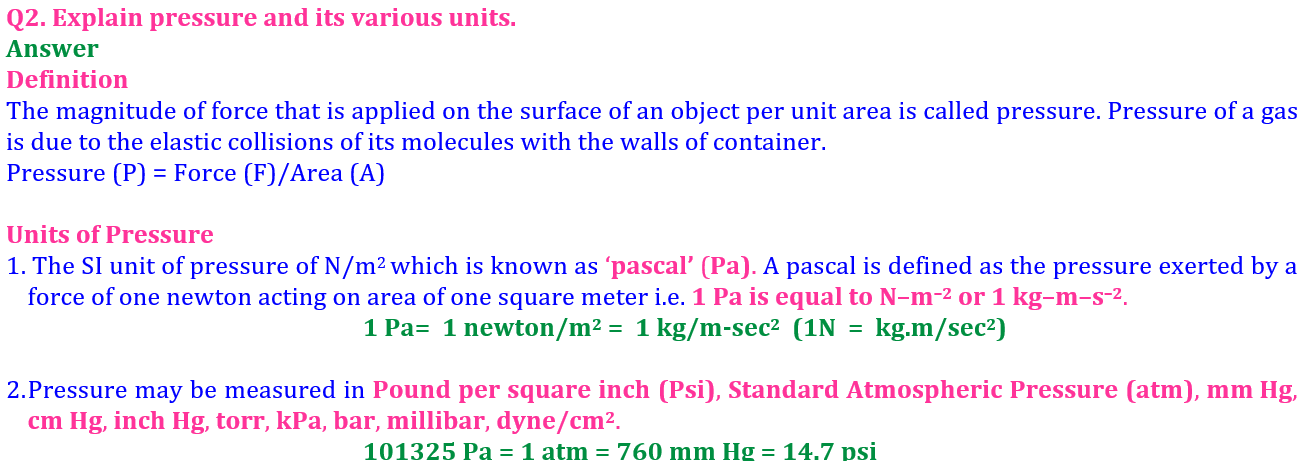
For numerical MCQs, always convert temperature to Kelvin and pressure to atm or Pa before applying PV = nRT.







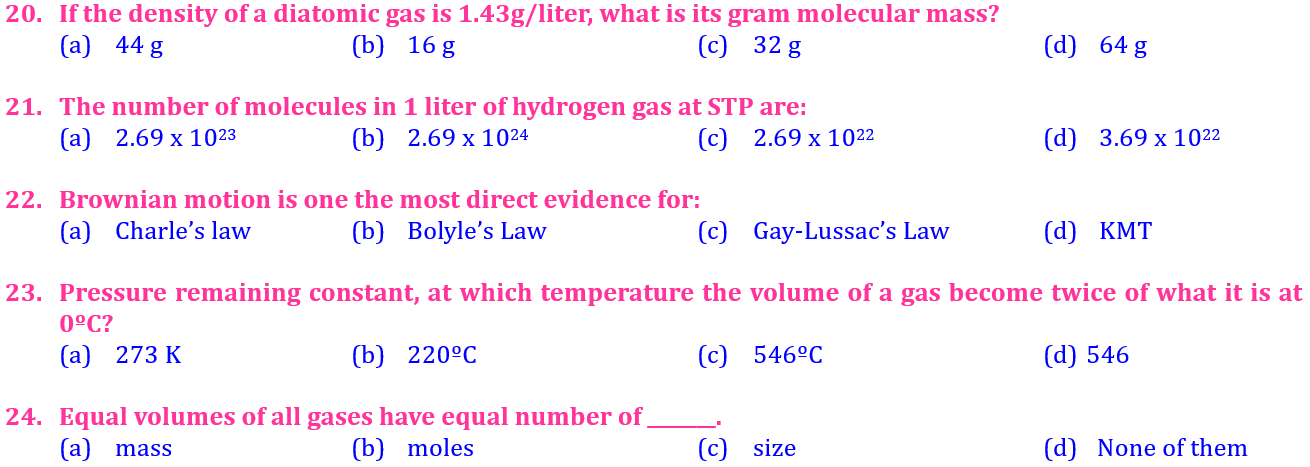


For answers Contact
at whatsapp
03009215999
🧪 MDCAT-style MCQs — Gaseous State (Chapter 4)
Model questions with answers & brief explanations — Learn Chemistry by Inam Jazbi.
1. Boyle’s Law (at constant T) can be expressed as:
A) P ∝ V
B) P ∝ 1/V
C) PV ∝ T
D) V ∝ T
Answer: B) P ∝ 1/V. Explanation: At constant temperature, pressure is inversely proportional to volume (PV = constant).
2. Charles’s Law states that at constant pressure:
A) V ∝ 1/T (K)
B) V ∝ T (K)
C) P ∝ T (K)
D) n ∝ V
Answer: B) V ∝ T (K). Explanation: Volume and absolute temperature are directly proportional at constant pressure (V/T = constant).
3. The ideal gas equation is:
A) PV = nRT
B) PV = k
C) P/T = constant
D) V = nRT
Answer: A) PV = nRT. Explanation: This combines Boyle's, Charles's and Avogadro's laws; R is the gas constant.
4. Molar volume of an ideal gas at STP (273 K, 1 atm) is:
A) 22.4 L·mol⁻¹
B) 11.2 L·mol⁻¹
C) 44.8 L·mol⁻¹
D) 2.24 L·mol⁻¹
Answer: A) 22.4 L·mol⁻¹. Explanation: One mole of ideal gas occupies 22.4 litres at STP (273 K, 1 atm).
5. If temperature (in K) is doubled for a fixed amount of gas in a sealed rigid container, what happens to pressure?
A) Pressure halves
B) Pressure doubles
C) Pressure unchanged
D) Pressure becomes zero
Answer: B) Pressure doubles. Explanation: At constant volume, P ∝ T (Gay-Lussac’s relation), so doubling T doubles P.
6. Dalton’s Law of Partial Pressures states:
A) Total pressure = product of partial pressures
B) Total pressure = sum of partial pressures
C) Partial pressures are always equal
D) Partial pressures depend on atomic mass
Answer: B) Total pressure = sum of partial pressures. Explanation: For non-reacting gases, P_total = P1 + P2 + ...
7. The gas constant R in SI units is:
A) 0.0821 L·atm·mol⁻¹·K⁻¹
B) 8.314 J·mol⁻¹·K⁻¹
C) 62.36 L·torr·mol⁻¹·K⁻¹
D) All of the above (units differ)
Answer: D) All of the above (units differ). Explanation: R's numeric value depends on the units chosen (8.314 J·mol⁻¹·K⁻¹ is SI).
8. Real gases deviate from ideal behaviour most when:
A) At high temperature and low pressure
B) At low temperature and high pressure
C) At standard conditions only
D) They never deviate
Answer: B) At low temperature and high pressure. Explanation: Under these conditions molecular volume and intermolecular forces become significant.
9. Graham’s law refers to:
A) Rate of effusion/diffusion inversely proportional to √(molar mass)
B) Relationship between pressure and volume
C) Kinetic energy of gas molecules
D) Calculation of partial pressures
Answer: A) Rate of effusion/diffusion inversely proportional to √(molar mass). Explanation: Rate1/Rate2 = √(M2/M1).
10. Which assumption is NOT part of the kinetic molecular theory of gases?
A) Gas molecules have negligible volume
B) All collisions are perfectly elastic
C) Strong attractive forces exist between molecules
D) Average kinetic energy depends on temperature
Answer: C) Strong attractive forces exist between molecules. Explanation: Kinetic theory assumes negligible intermolecular forces; strong attractions contradict ideal behaviour.
11. At constant temperature and pressure, equal volumes of different gases contain equal numbers of molecules. This statement is due to:
A) Avogadro’s Law
B) Boyle’s Law
C) Charles’s Law
D) Dalton’s Law
Answer: A) Avogadro’s Law. Explanation: Avogadro’s principle: V ∝ n (at constant P and T), so equal volumes contain equal moles (and molecules).
12. A container holds 2.00 mol of ideal gas at 300 K and 10.0 L. What is the pressure (in atm)? (Use R = 0.08206 L·atm·mol⁻¹·K⁻¹)
A) 0.492 atm
B) 4.92 atm
C) 0.164 atm
D) 49.2 atm
Answer: B) 4.92 atm. Explanation: Use PV=nRT → P = nRT/V = (2×0.08206×300)/10 = 4.9236 ≈ 4.92 atm.
Quick tips: Always convert temperature to Kelvin, use consistent units for R, and remember 1 mol gas ≈ 22.4 L at STP (273 K, 1 atm). For calculations use appropriate R (0.08206 for L·atm).
Tags
Avogadro’s Law
Boyle’s law
Charles’s Law
Dalton’s Law
First year
ideal gas equation
Kinetic Molecular Theory
MDCAT FSc Chemistry Notes
Real vs Ideal Gas
XI Chemistry Chapter 4
Very good 👍😊
ReplyDeleteMarvelous 😘😍
Good👍
ReplyDelete